Every sales team, agency, and operations lead eventually hits the same wall: a huge Google Sheets file where one wrong search breaks a report, a campaign list, or a client dashboard. Learning how to search properly is not a “spreadsheet nerd” skill; it’s how you keep revenue ops clean, reduce mistakes, and move from gut feeling to data-backed decisions.Google Sheets gives you powerful native tools: quick find with Ctrl+F or ⌘+F, deep “Find and replace” with options like match case, search across all sheets, and even regular expressions for patterns like dollar amounts or zip codes (see Google’s guide: https://support.google.com/docs/answer/62754). Once you understand these, you can slice through messy datasets in seconds.Now imagine delegating that work. Instead of you hunting through 20 tabs for bad phone numbers or outdated UTMs, an AI computer agent runs the searches, applies the rules, and hands you a clean summary.Why automate with an AI agent? Because the real value of your time is not pressing Ctrl+F 400 times. A Simular-style AI computer agent can:- Open your Google Sheet in the browser- Run consistent Find and replace passes for dozens of patterns- Log what it changed into an audit sheet- Repeat the routine daily or hourly without complaints.This turns searching in Google Sheets from a tedious chore into a background process that quietly protects your pipeline, reporting, and client deliverables.
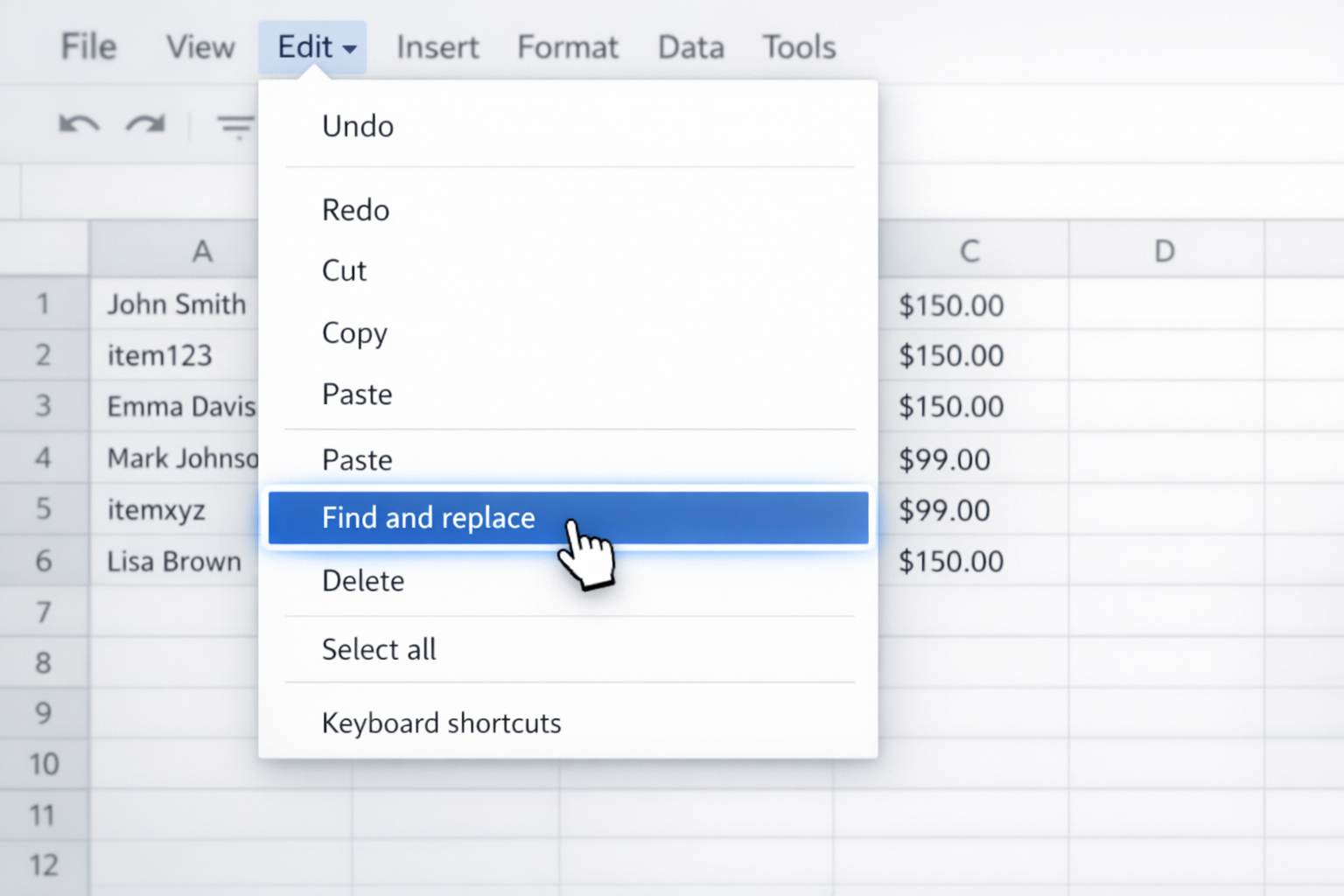
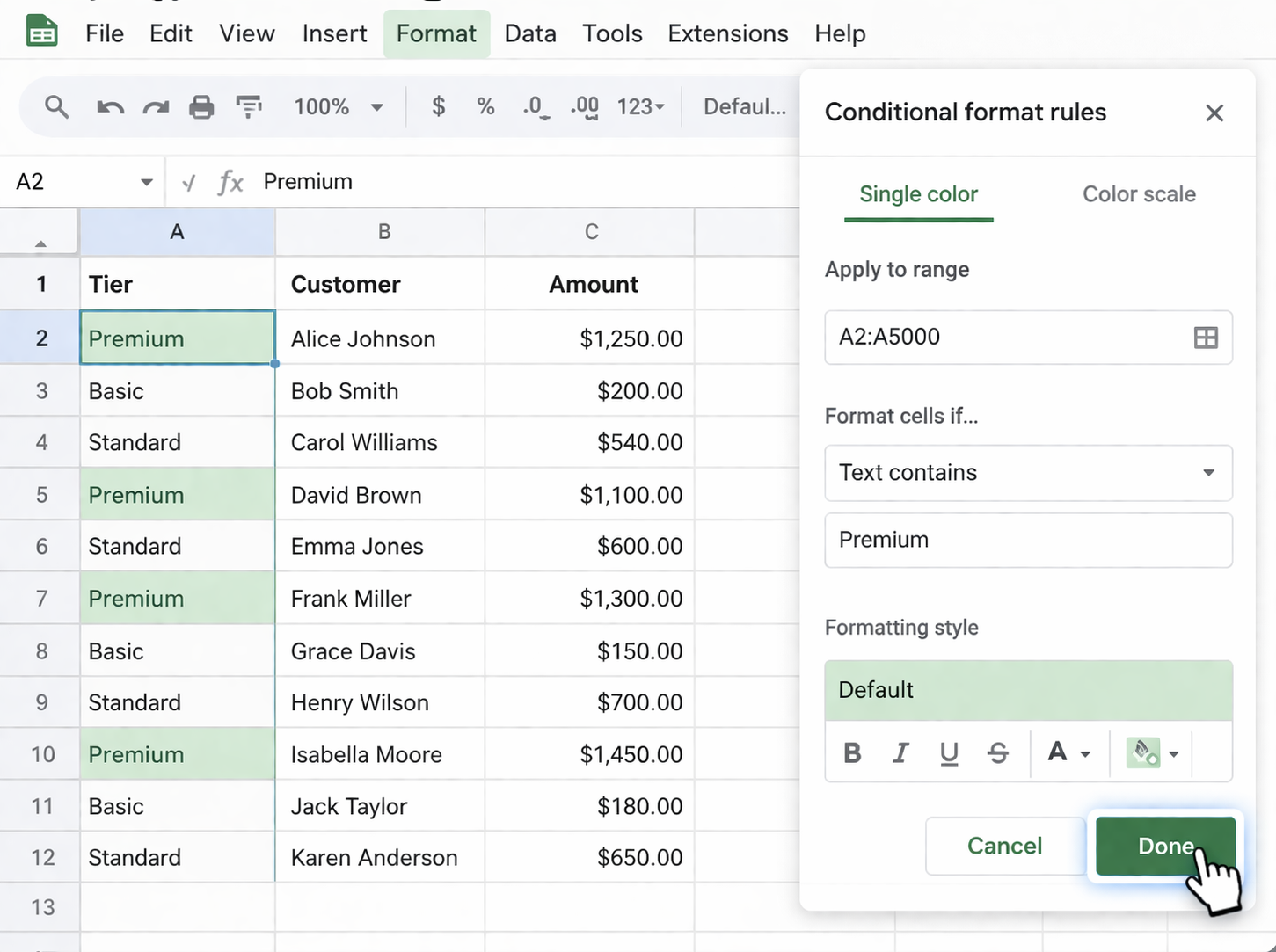
### 1. Manual ways to search in Google SheetsBefore you automate, you need to know what you’re automating. Here are the core manual methods every business owner, marketer, or ops lead should master.#### 1.1 Quick search with keyboard shortcuts (Ctrl+F / ⌘+F)This is your “binoculars” for a single sheet.1. Open your spreadsheet in Google Sheets.2. Press **Ctrl+F** on Windows or **⌘+F** on macOS.3. A small search box appears in the top-right.4. Type the word, email, or value you’re looking for.5. Use the up/down arrows in the search box (or Enter) to jump through each match.Use it when: you need to quickly locate a specific client name, campaign ID, or invoice number inside one tab.#### 1.2 Deep search with Edit → Find and replaceWhen you want more control—or to clean data—use **Find and replace**.1. Open your Sheet.2. Click **Edit → Find and replace**.3. In **Find**, enter the text or pattern you’re searching for.4. (Optional) In **Replace with**, enter the new value.5. Click **Find** to move through each match.6. Click **Replace** to change the current match, or **Replace all** to change every match.7. Use options to refine: - **Match case** for exact capitalization. - **Match entire cell contents** to avoid partial matches. - **Search within formulas** if the text may be inside a formula.Official Google help: https://support.google.com/docs/answer/62754#### 1.3 Search across all tabsIf your workbook has many tabs (e.g., by month, client, or region):1. Open **Edit → Find and replace**.2. In the **Search** dropdown, choose **All sheets** instead of **This sheet**.3. Run **Find** or **Replace all** as needed.This is perfect for hunting a client’s domain across dozens of campaign logs or reconciling a lead ID across multiple stages.#### 1.4 Pattern search with regular expressionsGoogle Sheets supports **regex** (regular expressions) inside Find and replace.1. Go to **Edit → Find and replace**.2. In **Find**, enter a regex such as: - `^\$([0-9,]+)?[.][0-9]+` to find dollar amounts - `[0-9]{5}(-[0-9]{4})?` for US ZIP codes3. Check **Search using regular expressions**.4. Click **Find** or **Replace all**.This is a power move for cleaning phone numbers, currencies, or IDs in bulk.Learn more: https://support.google.com/docs/answer/62754#### 1.5 SEARCH / FIND formulas for in-cell checksWhen you need search logic embedded in your sheet (e.g., flagging rows containing a specific keyword):- **SEARCH** (case-insensitive): ``` =IF(IFERROR(SEARCH("VIP", A2), 0) > 0, "VIP lead", "Standard") ``` This labels rows where column A contains “VIP”.Official SEARCH docs: https://support.google.com/docs/answer/3094154Use formulas when you want ongoing, automatic flagging instead of one-off manual searches.---### 2. No-code automation methodsOnce the basics are solid, you can reduce clicks using no-code tools and built-in automation.#### 2.1 Filter views for dynamic searchingInstead of searching each value manually, use filters to show only matching rows.1. Select your header row.2. Click **Data → Create a filter**.3. On the column you care about, click the filter icon.4. Choose **Filter by condition → Text contains** and enter your search term.Result: the sheet shows only rows matching “US”, “Facebook”, “High intent”, etc. You can save custom views for recurring searches.#### 2.2 Conditional formatting as a “visual search”Conditional formatting is a way to have Google Sheets visually highlight matches for you.1. Select the range (e.g., `A2:A5000`).2. Go to **Format → Conditional formatting**.3. Under **Format cells if**, choose: - **Text contains** for a simple keyword, or - **Custom formula is** with formulas like `=REGEXMATCH(A2, "VIP|High")`.4. Pick a highlight color.5. Click **Done**.Now, every time new data is added, matching cells light up automatically.#### 2.3 No-code platforms (Zapier / Make) to auto-searchFor recurring cross-tool workflows—like searching Google Sheets when a new lead hits your CRM—you can use no-code platforms.Typical Zapier-style flow:1. **Trigger**: “New lead in HubSpot/Pipedrive”.2. **Action**: “Find row in Google Sheets” where email or domain matches.3. **Next action**: Update the row, add a note, or send a Slack alert if not found.This way, the search happens in the background every time an event occurs. You never open the sheet; the automation reads and uses the data for you.---### 3. Scaling search with AI agents (Simular-style automation)Manual and no-code methods work—until the volume explodes. When you’re:- Cleaning 100k+ rows every week- Searching dozens of patterns- Jumping across multiple tools (Sheets, CRM, email, analytics)…you’re in AI agent territory. Simular Pro is designed for exactly this: an AI computer agent that uses your desktop and browser like a human, at scale.Official product overview: https://www.simular.ai/simular-proAbout the team and approach: https://www.simular.ai/about#### 3.1 Agent to run complex Find and replace playbooksImagine you maintain a huge performance report sheet for multiple clients.You can design an AI agent workflow that:1. Opens your Google Sheet in the browser.2. Navigates to **Edit → Find and replace**.3. Sequentially runs a library of search/replace rules you define, such as: - Replace misspelled campaign tags - Standardize currency symbols - Strip tracking parameters from URLs4. Logs each change to an “Audit” tab (date, rule, count of replacements).5. Saves and closes the sheet.**Pros:**- Zero manual clicking once set up.- Transparent execution: every action is visible and reviewable.- Scales to thousands or millions of steps, fitting enterprise reporting.**Cons:**- Requires initial design of rules and test runs.- Best suited when patterns are clear and stable.#### 3.2 Agent as a search concierge for sales and marketingFor agencies and sales teams, a Simular-style agent can:1. Open your “Master Leads” Google Sheet.2. Use Find and replace and filters to: - Search for all leads from a specific domain or ICP segment. - Flag rows where the **Status** is empty but **Last activity** is recent.3. Copy matching rows to a “Today’s Priority Outreach” tab.4. Optionally push that list into your CRM or email platform via webhooks.**Pros:**- Turns a messy lead sheet into a daily, ready-to-work call list.- Runs on schedule (e.g., every morning before your SDRs log in).**Cons:**- Requires alignment between your Sheet schema and the agent’s instructions.#### 3.3 At-scale quality checks and anomaly searchAnother pattern: use the agent as an always-on QA assistant.Workflow:1. Agent opens key reporting Sheets.2. Uses SEARCH/FIND formulas or inline Find and replace to look for: - Unexpected text (e.g., “N/A”, “ERROR”, “#VALUE!”). - Out-of-pattern values using regex.3. Writes a “Data Issues” summary tab and sends you a message (via Slack or email through your existing automations).**Pros:**- Catches issues before clients or leadership see them.- Frees analysts from manual sanity checks.**Cons:**- Needs careful tuning of what counts as an error or anomaly.By combining strong manual fundamentals, smart no-code tricks, and a production-grade AI computer agent like Simular Pro, you move Google Sheets search from “someone’s painful weekly chore” to an invisible, reliable part of your data engine.
Lorem ipsum dolor sit amet, consectetur adipiscing elit, sed do eiusmod tempor incididunt ut labore et dolore magna aliqua. Ut enim ad minim veniam, quis nostrud exercitation ullamco laboris nisi ut aliquip ex ea commodo consequat. Duis aute irure dolor in reprehenderit in voluptate velit esse cillum dolore eu fugiat nulla pariatur.
Block quote
Ordered list
Unordered list
Bold text
Emphasis
Superscript
Subscript
Start with the built-in quick search. Open your spreadsheet, then press Ctrl+F (Windows) or ⌘+F (Mac). A search box appears in the top-right. Type the value you’re looking for—an email, order ID, company name—and use the up/down arrows or Enter to cycle through each match on the current sheet.For deeper control, use Edit → Find and replace. This lets you:- Search within **all sheets** in the file, not just one tab.- Limit to formulas only (useful for tracking down a hard-coded URL or string).- Match capitalization or entire cell contents to avoid partial hits.If you repeatedly search for similar things (for example, all rows with “VIP” in a notes column), embed the logic with formulas like SEARCH or REGEXMATCH and then filter or sort by that helper column. Google’s official guide to Find and replace is here: https://support.google.com/docs/answer/62754
Find and Replace is ideal for fixing repeated issues such as bad tags, typos, or outdated terms. In Google Sheets:1. Go to **Edit → Find and replace**.2. In **Find**, type the text or pattern you want to fix—for example, `facebook.com`.3. In **Replace with**, enter the corrected version, such as `https://facebook.com`.4. Set the **Search** scope: This sheet or All sheets.5. Tick **Match case** if case matters, or **Match entire cell contents** if you want only exact matches.6. Click **Find** to preview each occurrence, then **Replace** to update one at a time, or **Replace all** to bulk update.For advanced cleaning, enable **Search using regular expressions** and use patterns like `[0-9]{5}(-[0-9]{4})?` for US ZIP codes. Always test on a small sample or a copy of the sheet first, especially when using Replace all. Full details: https://support.google.com/docs/answer/62754
SEARCH and FIND let you bake search logic directly into your spreadsheet so it runs continuously instead of as a one-off.- **SEARCH(search_for, text_to_search, [starting_at])** is case-insensitive. For example: `=IF(IFERROR(SEARCH("vip", A2), 0) > 0, "VIP lead", "Standard")` This returns “VIP lead” for any cell in A2 containing “vip”, “Vip”, or “VIP”.- **FIND** has the same syntax but is case-sensitive. Use it when “VIP” and “vip” should be treated differently.These functions return the position of the match in the text, or an error if not found, so you typically wrap them in IFERROR. Combine them with filters, conditional formatting, or pivot tables to build dashboards that automatically surface matching rows.Official SEARCH docs: https://support.google.com/docs/answer/3094154FIND docs: https://support.google.com/docs/answer/3094126
When your data is split across tabs—say, one sheet per month or client—manual Ctrl+F only searches the current tab. To search everything at once:1. Open your file in Google Sheets.2. Go to **Edit → Find and replace**.3. In **Find**, enter your search term, such as a domain, ID, or customer name.4. In the **Search** dropdown, change **This sheet** to **All sheets**.5. Click **Find** to move through each occurrence across the entire workbook.6. Optionally use **Replace** or **Replace all** if you’re correcting a term everywhere.If you frequently search by the same criteria, consider adding a consolidated index sheet that uses formulas like FILTER, QUERY, or IMPORTRANGE to bring relevant rows into one place. But for quick, one-off lookups, All sheets in Find and replace is the fastest built-in solution.
An AI agent like Simular Pro acts as a tireless assistant that operates your browser and desktop the way a human would, but at scale. Instead of you opening Sheets, clicking Edit → Find and replace, and running through dozens of patterns, you define the playbook once and let the AI computer agent execute it.A typical setup looks like this:1. You record or describe the workflow: open a specific Google Sheets URL, apply filters, run Find and replace with a list of terms, and write results to a log tab.2. In Simular Pro, you configure the agent with those steps and any parameters (e.g., which keywords, which columns, which tabs).3. You test on a copy of the sheet, reviewing every action through Simular’s transparent execution logs.4. Once it’s reliable, you trigger it via schedule or webhook—say, nightly—to clean new data automatically.The benefit is compound: fewer manual errors, consistent application of rules, and more time for your team to focus on strategy instead of hunting through cells.