If you have ever spent a late night hand-editing a QuickBooks chart of accounts template in Excel, you know the pain. Columns to align, account types to match, detail types to double check, GST or tax codes to set, and then the nerve‑wracking import into QuickBooks, hoping there are no red error rows.The template workflow itself is brilliant: start from a proven structure, customise for your industry, then import once into QuickBooks so every balance, P&L, and cash flow report is grounded in a clean CoA. But it is also fragile. One wrong account type, a duplicated name, or a bad date format and you are back in Excel hunting for what went wrong. For accountants, agencies, and operators doing this across dozens of clients, that friction multiplies fast.This is where pairing QuickBooks and Excel with an AI computer agent changes the story. Instead of you doing every click, the agent learns your preferred structure, edits templates in Excel, validates against QuickBooks rules, and even re‑runs imports when something fails. You become the architect of the chart of accounts; the agent becomes the tireless implementer, executing the same precise workflow at 11 pm that it did at 9 am.Delegating the QuickBooks chart of accounts template work to an AI agent means you stop babysitting spreadsheets and imports. The agent downloads templates, fills required green fields, enforces naming rules, and retries QuickBooks imports until everything is green. You review the result, not the tedious steps, freeing your time for pricing strategy, client advisory, or campaign planning.
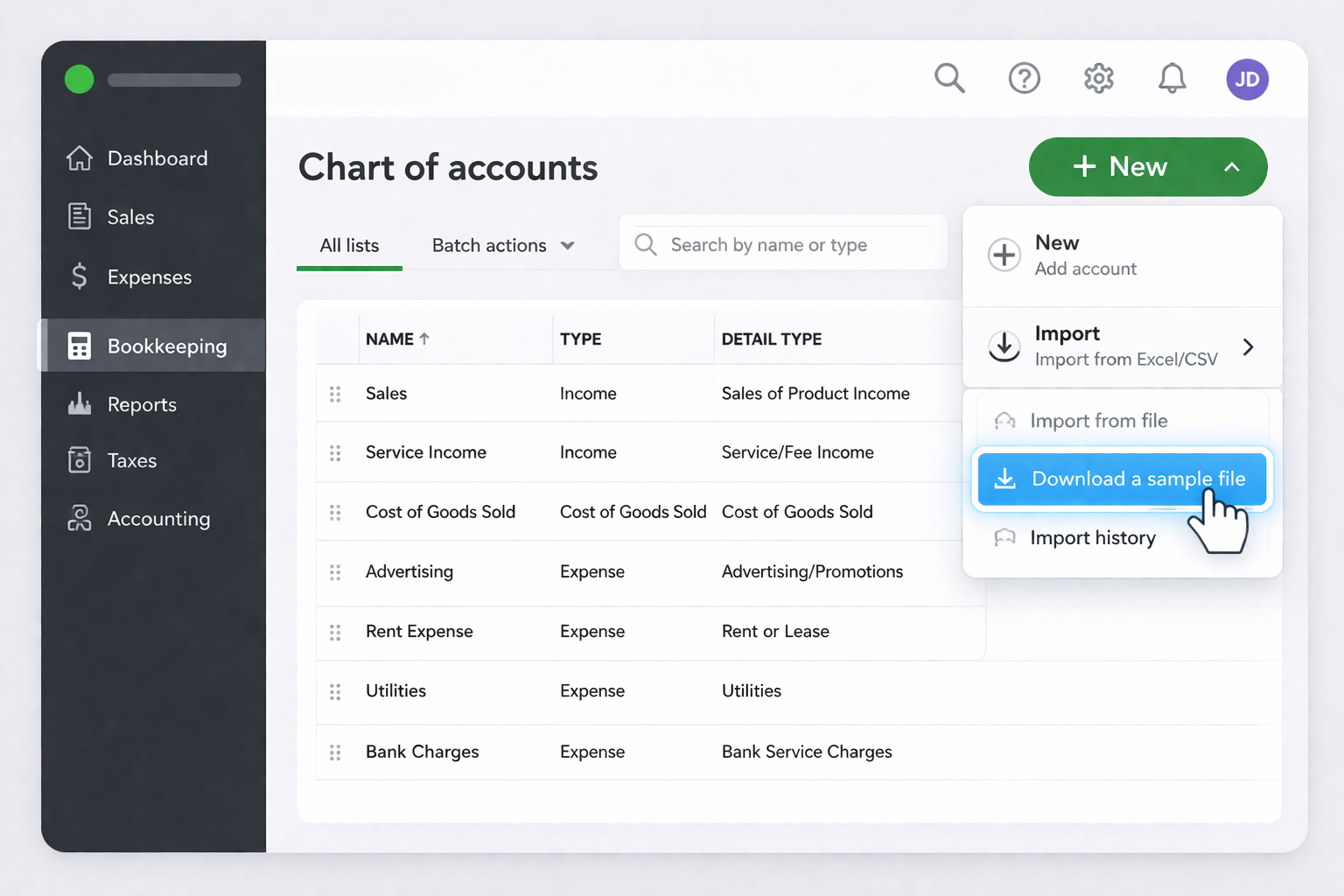
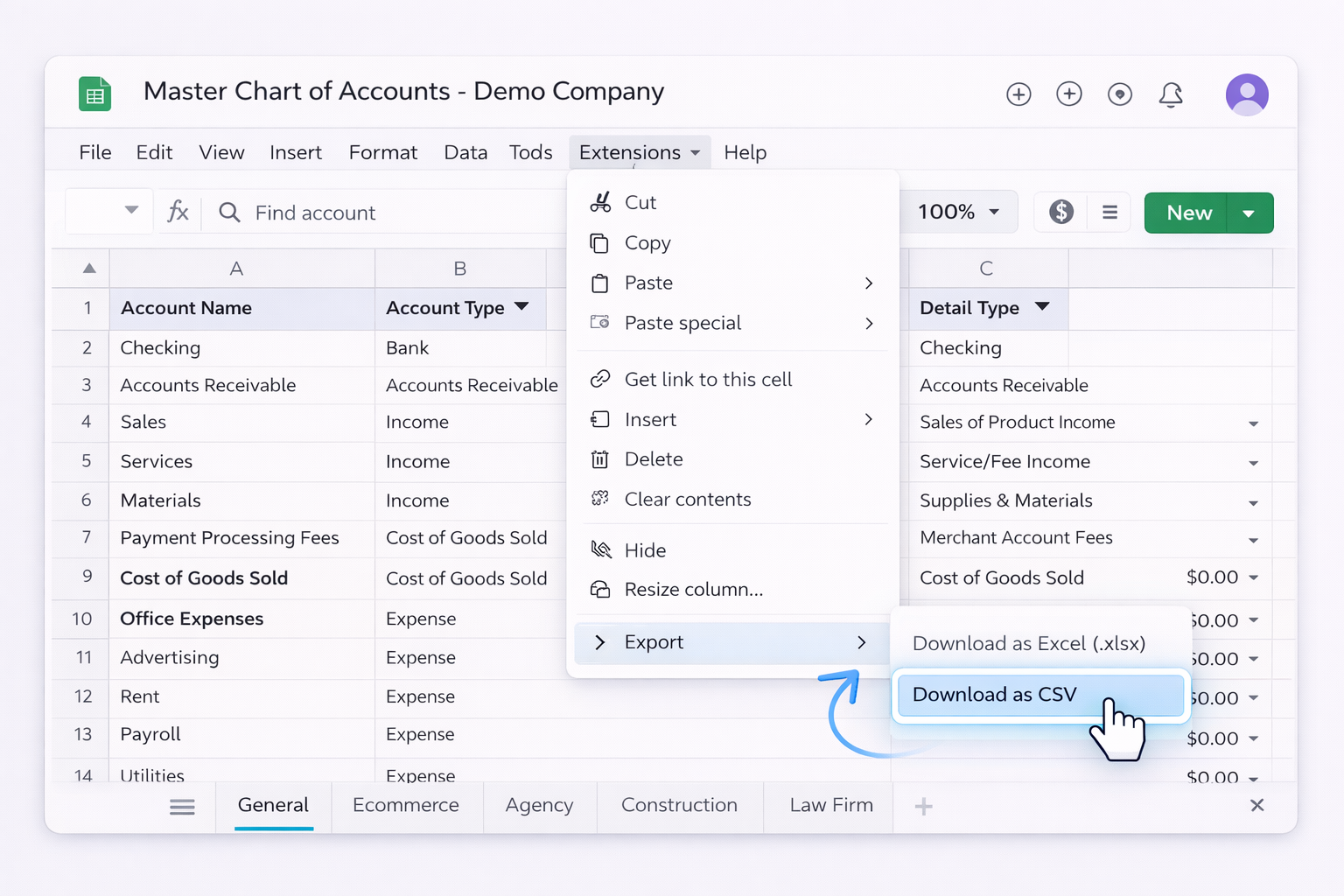
## 1. Traditional ways to manage QuickBooks CoA templates in ExcelThese are the classic, fully manual methods most firms start with.### 1.1 Download the official QuickBooks template1. Sign in to QuickBooks Online.2. Go to Bookkeeping → Chart of accounts.3. Click the dropdown next to New, choose Import.4. Select 'Download a sample file' to get the Excel template. Official guide: https://quickbooks.intuit.com/learn-support/en-au/help-article/accounting-bookkeeping/set-chart-accounts-using-quickbooks-online/L2yc6KBob_AU_en_AU### 1.2 Explore and respect the template structure1. Open the Excel file.2. Review column headers such as Account Name, Account Type, Detail Type, Tax Rate, and Opening Balance.3. Do not edit row 1 headers or change file type; keep xlsx or csv.4. Note which columns are marked as required (typically highlighted in green in the Intuit template).### 1.3 Manually customise your chart of accounts1. Add or rename accounts to match your business or client industry.2. For each row, choose an Account Type and Detail Type from the allowed QuickBooks lists. The allowed types are documented here: https://quickbooks.intuit.com/learn-support/en-us/help-article/chart-accounts/import-chart-accounts/L9Res1eb1_US_en_US3. Set Tax or GST rates where required. Ensure GST is configured first: https://community.intuit.com/articles/17627614. Optionally enter Opening Balances and Dates for starting figures.### 1.4 Create account hierarchies in ExcelQuickBooks supports header and sub-accounts:1. Choose a header account name, for example 'Marketing'.2. On the next row, in Account Name, enter 'Marketing:Advertising' to create a sub-account.3. Use the same Account Type for header and sub-accounts (for example, Expenses).4. Repeat for other rollups such as 'Travel:Airfare', 'Travel:Lodging'.### 1.5 Import into QuickBooks and fix errors1. In QuickBooks Online, return to Bookkeeping → Chart of accounts → Import.2. Upload your edited Excel file.3. Map columns from your file to QuickBooks fields.4. At step 3 of the import, review any red‑flagged errors. Intuit’s error reference is in the same help article: account name, type, tax rate, currency, and date format issues are common.5. Switch back to Excel, correct the rows, save, and re‑import until all rows pass.**Pros:** Full control, no extra tools, ideal for a first‑time setup.**Cons:** Slow, error‑prone, hard to repeat across many entities or frequent restructures.## 2. No-code automation with tools like Zapier and MakeOnce you move beyond one business, you start feeling the drag of repetition. Here are no‑code patterns to speed things up without writing code.### 2.1 Central CoA master in Excel or Google Sheets1. Build a master chart of accounts workbook with separate tabs per industry or client segment.2. Use formulas and data validation lists to standardise Account Type and Detail Type values so they always match QuickBooks options.3. When creating a new company, duplicate the relevant tab, tweak names, then export just that tab as csv.4. Import the csv into QuickBooks using the standard import flow.**Pros:** One source of truth, fewer ad‑hoc edits, still human‑friendly.**Cons:** Still manual exporting and importing, and you must keep QuickBooks account type lists in sync by hand.### 2.2 No-code workflows for template distributionUse Zapier, Make, or Power Automate to orchestrate files.Example workflow:1. Trigger: New QuickBooks company or new client record in your CRM.2. Action: No‑code tool copies the right CoA tab from a master Google Sheet into a new Sheet or Excel file.3. Action: Save that file into a shared folder (OneDrive, SharePoint, or Google Drive) named after the client or entity.4. Human step: Accountant reviews the file, then imports into QuickBooks.**Pros:** Automates file preparation and naming, useful for agencies and bookkeeping firms onboarding many clients.**Cons:** Still relies on a person to open QuickBooks and run the import; error handling is manual.### 2.3 Validation helpers inside Excel1. Use Excel data validation lists for Account Type, Detail Type, and Tax Rate, sourced from a locked reference tab.2. Add conditional formatting to highlight missing required fields or duplicate Account Names.3. Use simple formulas to ensure account numbers are unique. Excel reference: https://support.microsoft.com/en-us/office/create-or-remove-a-drop-down-list-7693307a-59ef-400a-b769-c5402dce407b**Pros:** Reduces import errors before you ever touch QuickBooks.**Cons:** Still spreadsheet‑centric, and rules must be updated with every QuickBooks change.## 3. Scaling with AI agents (Simular) across QuickBooks and ExcelAt some point, even no‑code flows are not enough. You are still the one clicking through QuickBooks imports, opening Excel, and hunting down mismatched types. This is where an AI computer agent like Simular Pro turns your CoA workflow into a repeatable, autonomous process.Simular is a production‑grade computer use agent that can operate across your desktop, browser, and cloud apps. It can open Excel, manipulate templates, log into QuickBooks, and run long, multi‑step workflows with transparent, inspectable steps.### 3.1 Method 1: Agent as your CoA template operator**Workflow:**1. You drop a new client brief into a folder or a CRM note describing industry, tax region, and any special accounts.2. The Simular agent opens the official QuickBooks Excel sample file, clones your master CoA tab, and adjusts names and tax codes based on the brief.3. It validates required columns, checks uniqueness of Account Names and Numbers, and applies your hierarchy conventions.4. The agent signs into QuickBooks Online, navigates to Bookkeeping → Chart of accounts → Import, uploads the file, maps fields, and runs the import.5. If QuickBooks flags any rows in red, the agent reads the error messages, switches back to Excel, fixes the data, saves, and retries until successful.**Pros:** Massive time savings, consistent execution, ideal for firms managing dozens or hundreds of entities.**Cons:** Requires an initial investment in designing and testing the workflow; best suited to stable, well‑defined CoA standards.Official QuickBooks import docs to reference in your agent instructions: https://quickbooks.intuit.com/learn-support/en-us/help-article/chart-accounts/import-chart-accounts/L9Res1eb1_US_en_US### 3.2 Method 2: Continuous CoA maintenance at scaleBeyond initial setup, charts of accounts drift: new product lines, new marketing channels, new tax rules.**Workflow:**1. You maintain a master CoA definition in Excel or Sheets.2. On a schedule, Simular opens the master file, compares each client’s current QuickBooks CoA (exported via the QuickBooks interface to Excel) against the standard.3. It highlights or auto‑adds missing accounts in the client template and runs the import back into QuickBooks.4. A summary report is generated into a Google Sheet or Excel file, listing what changed per client.**Pros:** Keeps every entity aligned to your standard without you reconciling lists one by one.**Cons:** Needs careful governance so automated changes do not conflict with bespoke client requirements.### 3.3 Method 3: Error‑handling and troubleshooting conciergeQuickBooks imports often fail for small reasons: dates, currencies, duplicate names.With Simular:1. The agent monitors import attempts in QuickBooks.2. When it sees red‑flag errors, it captures screenshots, parses the error list, and opens the source Excel file.3. It corrects formats and values according to rules you define (for example, date formats or naming conventions), then retries the import.4. If an error cannot be auto‑resolved, it posts a summary note to your team (for example, in Slack or email) with exactly which rows need a human decision.**Pros:** You almost never see raw error dialogs; you see curated issues. Great for busy finance teams.**Cons:** Requires clear exception policies so the agent knows when to stop and escalate.By combining the official QuickBooks and Excel templates with an AI computer agent, you keep the reliability of Intuit’s workflow while offloading the drudgery. You design the chart of accounts; the agent does the clicking, formatting, and re‑trying, at a scale no human team could match.
Lorem ipsum dolor sit amet, consectetur adipiscing elit, sed do eiusmod tempor incididunt ut labore et dolore magna aliqua. Ut enim ad minim veniam, quis nostrud exercitation ullamco laboris nisi ut aliquip ex ea commodo consequat. Duis aute irure dolor in reprehenderit in voluptate velit esse cillum dolore eu fugiat nulla pariatur.
Block quote
Ordered list
Unordered list
Bold text
Emphasis
Superscript
Subscript
Start by downloading Intuit’s official sample file. In QuickBooks Online, go to Bookkeeping, select Chart of accounts, click the dropdown next to New, and choose Import. From there, select the option to download a sample file. Open this Excel file and leave row 1 headers untouched, as QuickBooks depends on them. Fill in Account Name, Account Type, and Detail Type for each row. Use Intuit’s list of supported types, documented here: https://quickbooks.intuit.com/learn-support/en-us/help-article/chart-accounts/import-chart-accounts/L9Res1eb1_US_en_US so your imports will not fail. Create parent and sub‑accounts using the header:subaccount pattern, for example Marketing:Advertising. Add opening balances and dates only if you are starting mid‑year and know the correct figures. Once done, save as xlsx or csv, then return to the Import screen in QuickBooks, upload the file, map the columns, and run the import. Fix any red‑flag errors by updating the Excel file and retrying.
Most errors come from small mismatches between your Excel data and what QuickBooks expects. Before importing, validate the template. In Excel, use data validation lists for Account Type, Detail Type, and Tax Rate that mirror QuickBooks’ allowed values. You can build a hidden reference tab with the official lists and point your validations to those cells. Add conditional formatting to highlight blanks in required columns (Account Name, Account Type, Detail Type) and to flag duplicate Account Names or Numbers. Make sure dates use an unambiguous format such as yyyy-mm-dd and that Opening Balance contains only numeric values. When you import, read any QuickBooks error messages closely; they will tell you if a name is duplicated, a type is invalid, or a tax code is missing. Adjust your Excel file accordingly and re‑import. Intuit’s help article on troubleshooting import errors is a useful reference while you refine your template.
A good chart of accounts is both readable and flexible. In QuickBooks, you create hierarchy by using a header account and then a sub‑account with a colon syntax in the name. For example, you might define a header called Marketing, then sub‑accounts such as Marketing:Advertising, Marketing:Events, and Marketing:Software. All of these should share the same Account Type, usually Expenses. In your Excel template, place the header name in one row and the header:subaccount names in subsequent rows. This gives you clean rollups in P&L reports while still allowing detailed analysis. Group similar costs under logical parents such as Travel, Payroll, or Revenue, but do not create so many sub‑accounts that reporting becomes cluttered. Think about how you want to slice campaigns, channels, or product lines, then design the hierarchy to answer those questions with a single report run.
Yes, and for agencies and accounting firms, this is usually the smartest path. Build a master chart of accounts in Excel with all the accounts you would want any typical client in that segment to have. Use separate tabs for different industries, such as ecommerce, SaaS, or professional services. Lock the structure of the master tab and only allow edits via a controlled change process so it remains your single source of truth. For each new client, duplicate the relevant tab, rename it, and tailor only what is necessary, such as adding a few client‑specific revenue lines. Save that tab as its own xlsx or csv and import into the client’s QuickBooks company. Over time, when you improve the master structure, you can decide whether to retro‑fit existing clients by re‑running the template or manually adding key new accounts. This reuse dramatically reduces setup time and keeps reporting comparable across your portfolio.
AI agents like Simular act as tireless assistants that handle the mechanical parts of your chart of accounts workflow. Instead of you downloading templates, opening Excel, filling green cells, checking for duplicates, logging into QuickBooks, mapping fields, and resolving errors, the agent does these steps on your behalf. You define the rules once: which master template to start from, how to name accounts for certain industries, how to map tax codes, and what to do when QuickBooks throws a specific error. The agent then executes this multi‑step process across desktop, browser, and cloud, with every action logged and inspectable. For firms with many entities, the agent can run overnight batches, updating or creating charts of accounts for dozens of companies while your team sleeps. You review dashboards and exception reports instead of raw spreadsheets, freeing your time for advisory work, pricing strategy, or campaign analysis rather than repetitive setup tasks.