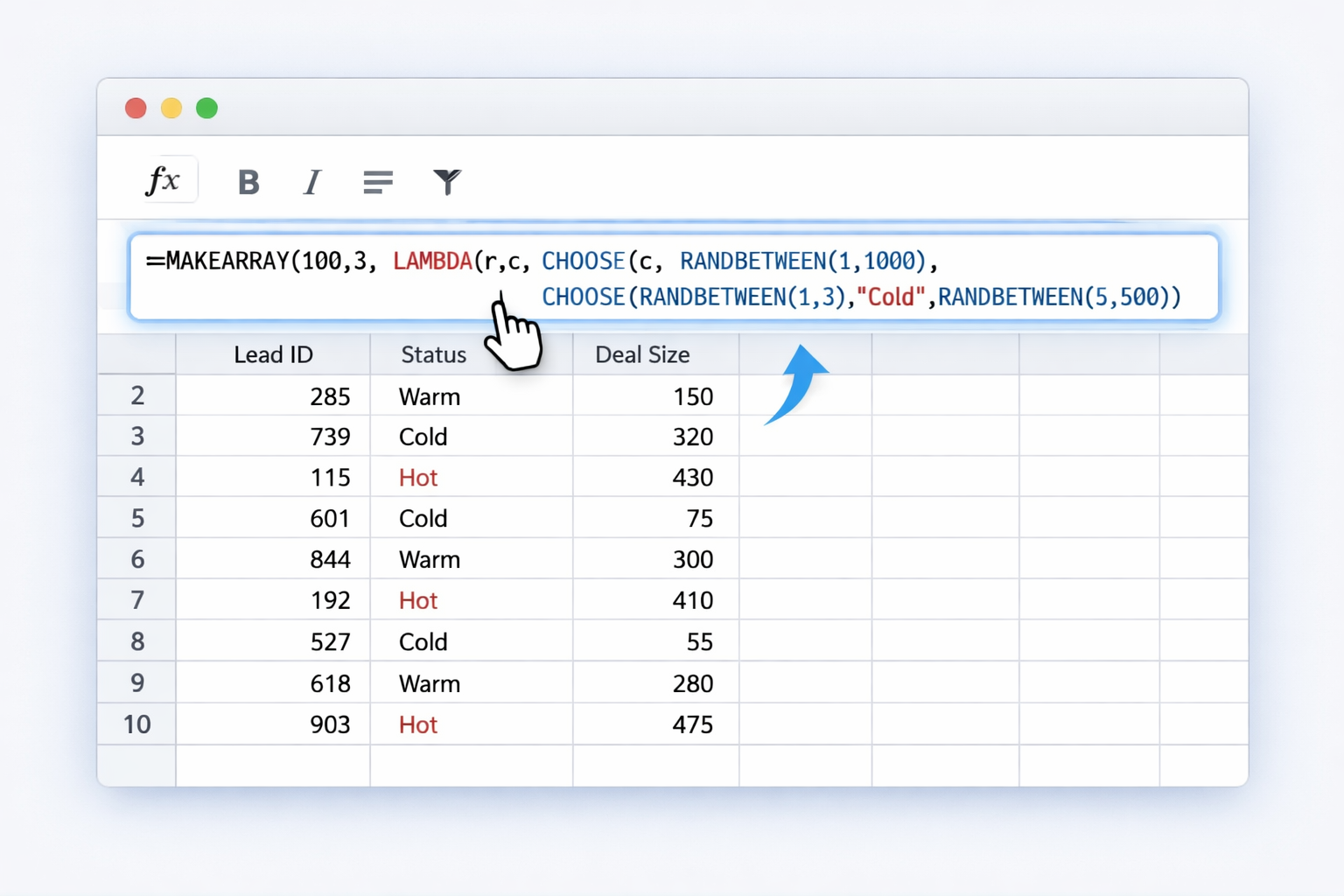
In a sales or agency team, MAKEARRAY is like a grid generator on steroids. In Excel, =MAKEARRAY(rows, cols, LAMBDA(r,c,calc)) builds entire tables in one hit, filling each cell with logic instead of copy‑pasted formulas. You can spin up pricing matrices, funnel simulations, A/B test grids, even randomized sample data using RANDBETWEEN and CHOOSE.The magic is that your structure becomes declarative: you describe the pattern once and Excel does the rest. No more dragging fill handles across thousands of rows or rebuilding layouts when your CEO asks for “just one more segment”.Now imagine an AI computer agent watching over those workbooks. Instead of you tweaking row and column counts or hunting #VALUE! errors, the agent updates MAKEARRAY arguments, adjusts LAMBDA functions, and regenerates tables on demand. You stay focused on campaign strategy or pipeline reviews while the agent mass-updates sheets, tests scenarios and keeps formulas consistent across every client file.
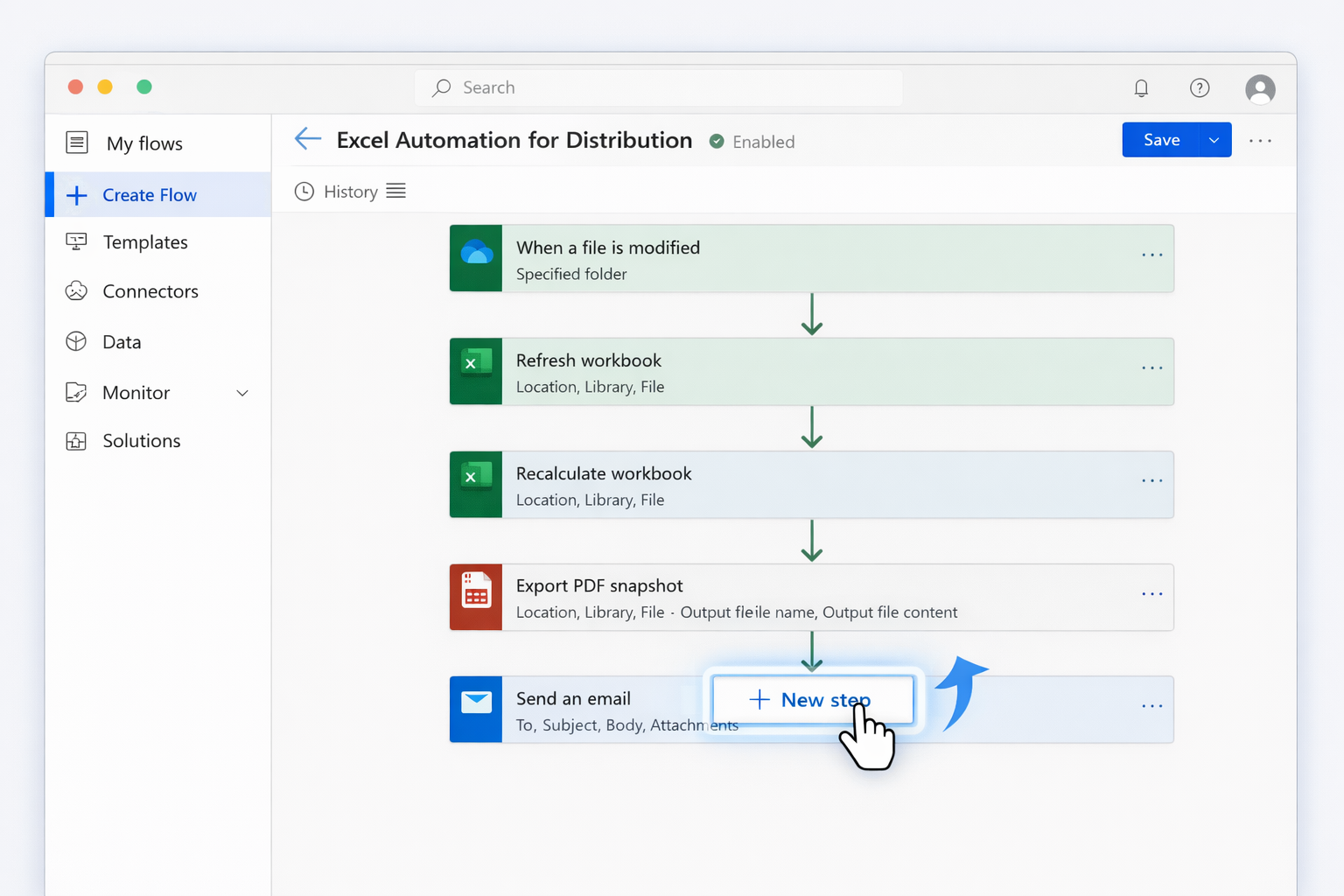
# Top Ways to Use and Automate MAKEARRAY-Style LogicBusiness owners, agencies, and sales teams live inside spreadsheets. MAKEARRAY in Excel (and its cousins in Google Sheets) let you turn those spreadsheets into programmable canvases. Let’s walk through practical ways to use it manually, with no-code tools, and finally at scale with an AI agent.---## 1. Manual methods inside Excel and Google Sheets### 1.1 Basic MAKEARRAY in ExcelStart with the official Microsoft docs: https://support.microsoft.com/en-us/office/makearray-function-b80da5ad-b338-4149-a523-5b221da09097**Goal:** Create a calculated table, e.g., a lead-scoring grid.1. Open Excel (Microsoft 365 / Excel 2024+).2. Select the cell where you want the top-left of your table.3. Enter a simple MAKEARRAY formula: ``` =MAKEARRAY(5,3,LAMBDA(r,c,2*r*c)) ``` This returns a 5×3 array where each cell is `2 * row * column`.4. Press Enter. Excel “spills” the array into adjacent cells.Adapt this for business logic:``` =MAKEARRAY(lead_rows,criteria_cols, LAMBDA(r,c, base_score + r*c))```You can reference named ranges inside the LAMBDA to use pricing tiers, regions, or funnel stages.### 1.2 Random test data for campaignsUse MAKEARRAY with RANDBETWEEN and CHOOSE to simulate leads or orders:``` =MAKEARRAY(100,3, LAMBDA(r,c, CHOOSE(c, RANDBETWEEN(1,1000), CHOOSE(RANDBETWEEN(1,3),"Cold","Warm","Hot"), RANDBETWEEN(5,500) ) ))```* Column 1: Lead ID* Column 2: Lead status* Column 3: Deal sizeThis lets marketers test dashboards and forecasts before the real data arrives.### 1.3 Guarding against errorsMAKEARRAY expects **scalar** row/column counts and a valid LAMBDA.* If `rows < 1` or `cols < 1`, you’ll get `#VALUE!`.* If your LAMBDA signature doesn’t match `(row, col)`, you’ll also get `#VALUE!`.Wrap sensitive calculations in IFERROR:``` =IFERROR( MAKEARRAY(10,5,LAMBDA(r,c,1/(r-c))), "Check LAMBDA logic")```### 1.4 Google Sheets equivalentsGoogle Sheets doesn’t have MAKEARRAY yet, but you can **replicate the behavior** with dynamic array functions like `ARRAYFORMULA`, `MAP`, `BYROW`, and `BYCOL`.Official help center: https://support.google.com/docs**Example: Multiplication table with MAP**1. In A1, create your row indices: ``` =SEQUENCE(5) ```2. In B1, create your column indices: ``` =SEQUENCE(1,3) ```3. Use MAP with LAMBDA-style logic: ``` =MAP(A1:A5,LAMBDA(r, BYCOL(B1:D1,LAMBDA(c,r*c)) )) ```Conceptually, this mirrors:``` MAKEARRAY(5,3,LAMBDA(r,c,r*c))```### 1.5 Visual layouts for dashboardsAgencies often need neat grids for campaign results, by channel and by week. In Excel, you can drive that with MAKEARRAY and references to header ranges:``` =MAKEARRAY(ROWS(channels),COLUMNS(weeks), LAMBDA(r,c, INDEX(results,r,c)))```This keeps layout logic in one formula instead of scattered references.---## 2. No-code automation with spreadsheet toolsOnce your MAKEARRAY or MAKEARRAY-style logic is in place, you can layer automation on top—without writing code.### 2.1 Excel + Power AutomateUse **Power Automate** to refresh and distribute MAKEARRAY-driven workbooks.1. Design your Excel file with named ranges controlling `rows`, `cols`, and any LAMBDA parameters.2. Store it in OneDrive or SharePoint.3. In Power Automate, create a flow: * Trigger: “When a file is modified” or on a **scheduled** basis. * Actions: * Refresh the workbook. * Recalculate (automatic with open/close or use Office Scripts if needed). * Export a PDF snapshot. * Email it to stakeholders.**Result:** You change one control cell (e.g., number of simulations, time periods) and the flow pushes updated MAKEARRAY tables to clients overnight.### 2.2 Google Sheets + Apps Script (low-code)In Sheets, combine dynamic arrays with a small Apps Script to automate updates.1. Build your MAP/BYROW formula to mimic your MAKEARRAY logic.2. In **Extensions → Apps Script**, write a script that: * Changes the input range (e.g., number of rows via a SEQUENCE function). * Forces recalculation if needed. * Sends a PDF or CSV export.3. Schedule it using **Triggers** → “Time-driven”.Even a few lines of script turn your Sheets model into an automated report engine.### 2.3 Zapier/Make with Sheets or ExcelUse a no-code automation platform to connect your CRM or ad platforms.*Trigger:* New leads or campaign metrics.*Actions:*- Append raw data to a Google Sheet or Excel Online file.- Let your existing MAKEARRAY (or MAP/BYROW) formulas transform that raw data into clean matrices.- Push results (summaries, scores, cohorts) back into your CRM or Slack.This way, MAKEARRAY becomes the transformation brain sitting inside your spreadsheet, while no-code tools handle movement of data.---## 3. Scaling with AI agents (Simular) at desktop levelTraditional automations break when layouts change or new tools appear. This is where a **Simular AI computer agent** shines: it behaves like a power user who understands Excel, Google Sheets, and your workflows.### 3.1 Agent-powered template rolloutImagine you run a marketing agency onboarding ten new clients this month. Each needs:- A traffic & leads workbook in Excel using MAKEARRAY for scenarios.- A collaboration-friendly Google Sheet mirroring the same logic.You can:1. Record one “golden” template with MAKEARRAY and Sheets dynamic arrays.2. In Simular Pro (https://www.simular.ai/simular-pro), create an agent that: - Duplicates the template file per client. - Renames sheets and tabs. - Updates ranges (rows, columns, LAMBDA logic) based on client-specific assumptions. - Connects each file to the right data source (CSV export, CRM download, etc.).**Pros:**- Human-like flexibility across desktop, browser, and cloud.- Works even when UI layouts change.**Cons:**- Requires a short onboarding run where you show the agent what “good” looks like.### 3.2 Continuous QA on formulasMAKEARRAY errors (`#VALUE!`, wrong dimensions) often surface after someone tweaks inputs. Instead of a human chasing broken cells, a Simular agent can:- Open scheduled workbooks daily.- Scan for errors and broken spill ranges.- Compare results to historical baselines.- If something looks off, revert the last change or flag you in Slack/email.You maintain strategic control; the agent handles low-level formula hygiene.### 3.3 End-to-end campaign workflowsBecause Simular agents can operate across browser, desktop, and cloud, you can design flows like:1. Pull fresh campaign data from ad platforms.2. Drop it into your Google Sheets raw data tab.3. Let MAP/BYROW/ARRAYFORMULA (MAKEARRAY-style logic) reorganize it.4. Export a cleaned CSV and open Excel locally.5. Run MAKEARRAY-driven models (e.g., revenue forecasts, scenario tables).6. Export a polished dashboard to PDF and upload to your client portal.**Pros:**- Almost zero human clicks once the flow is stable.- Highly transparent: in Simular Pro you can see every step the agent takes.**Cons:**- Best suited to teams ready to standardize on a few core spreadsheet templates.With this stack—manual mastery, no-code automation, and a Simular AI computer agent—you stop babysitting spreadsheets and start orchestrating them at scale.

Lorem ipsum dolor sit amet, consectetur adipiscing elit, sed do eiusmod tempor incididunt ut labore et dolore magna aliqua. Ut enim ad minim veniam, quis nostrud exercitation ullamco laboris nisi ut aliquip ex ea commodo consequat. Duis aute irure dolor in reprehenderit in voluptate velit esse cillum dolore eu fugiat nulla pariatur.
Block quote
Ordered list
Unordered list
Bold text
Emphasis
Superscript
Subscript
Think of your first MAKEARRAY model as a way to describe a whole table in one formula. Start simple:1. Decide how many rows and columns you want. For example, 5 rows of lead stages by 3 pricing tiers.2. In a blank cell, enter: =MAKEARRAY(5,3,LAMBDA(r,c,r*c)) This returns a 5×3 grid where each cell is the row number times the column number.3. Replace `r*c` with a business formula. For instance, to calculate a discount matrix: =MAKEARRAY(5,3,LAMBDA(r,c, base_price*(1 - 0.05*r - 0.02*c))) Put `base_price` in a separate cell and reference it.4. Press Enter and let the array spill. Adjust the row/column counts as your model grows.Microsoft’s official docs (https://support.microsoft.com/en-us/office/makearray-function-b80da5ad-b338-4149-a523-5b221da09097) have more examples you can adapt to your use cases.
Google Sheets doesn’t have MAKEARRAY yet, but you can achieve the same behavior using dynamic array functions like SEQUENCE, ARRAYFORMULA, MAP, BYROW and BYCOL.Here’s a practical pattern:1. Create your row indices: =SEQUENCE(5)2. Create your column indices: =SEQUENCE(1,3)3. Build a multiplication table using BYROW and BYCOL: =BYROW(SEQUENCE(5),LAMBDA(r, BYCOL(SEQUENCE(1,3),LAMBDA(c,r*c)) )) This produces a 5×3 grid similar to: =MAKEARRAY(5,3,LAMBDA(r,c,r*c)) in Excel.4. Swap `r*c` for your business logic: lead scores, pricing, or allocation percentages.Use the Google Docs Editors Help Center (https://support.google.com/docs) to look up MAP, BYROW, and BYCOL for more patterns you can chain together.
Most #VALUE! errors in MAKEARRAY come from two issues: invalid row/column counts or a broken LAMBDA.Work through this checklist:1. **Check rows and cols** - Ensure both are positive numbers: `rows>0` and `cols>0`. - If they’re references (like A1,B1), confirm those cells contain numeric values.2. **Validate your LAMBDA signature** - MAKEARRAY expects `LAMBDA(row, col, calculation)`. - If you pass a LAMBDA that uses a different number of parameters, you’ll get #VALUE!.3. **Test the LAMBDA separately** - Wrap it in a helper formula: =LAMBDA(r,c, your_calc_here)(1,1) - If that errors, fix the logic before putting it into MAKEARRAY.4. **Guard with IFERROR** - For user-facing sheets, use: =IFERROR(MAKEARRAY(...),"Check inputs")Refer back to Microsoft’s MAKEARRAY guide for details on parameter rules and error messages.
For marketers, MAKEARRAY is perfect for spinning up quick simulations without a data warehouse.Example: You want to simulate revenue for combinations of traffic, conversion rate, and average order value (AOV).1. In Excel, create three SEQUENCE-based columns representing traffic scenarios, conversion rates, and AOV.2. Use MAKEARRAY to generate a grid of combinations: =MAKEARRAY(ROWS(traffic),COLUMNS(conv_rates), LAMBDA(r,c, INDEX(traffic,r) * INDEX(conv_rates,c) * aov ) )3. Turn that grid into a heat map with conditional formatting to visually spot high-ROI pockets.4. Add sliders or input cells that change traffic and conversion assumptions; MAKEARRAY recalculates the whole surface instantly.This lets you explore “what if we doubled paid search?” or “what if email CTR improves by 20%?” without manually rebuilding tables every time.
When you have dozens of client workbooks, the real pain isn’t writing one MAKEARRAY formula—it’s maintaining them all. That’s where an AI agent like Simular becomes valuable.A Simular agent can:1. Open Excel and Google Sheets across desktop and browser.2. Locate key control cells (rows, cols, discount rates, segment counts).3. Update those values based on a schedule, CRM exports, or your prompts.4. Recalculate MAKEARRAY-driven tables and check for #VALUE! or spill errors.5. Export refreshed reports (PDF, CSV) and upload or email them.Instead of a human analyst spending hours clicking through files, the agent runs the same playbook consistently, with production-grade reliability and transparent execution you can review. You decide the strategy; the AI computer agent keeps every MAKEARRAY model in sync across your portfolio.