Oops! Something went wrong while submitting the form.
How to Do a Contract Review: The Complete Checklist
The 12-point contract review checklist used by legal teams, plus three methods — manual, software, and AI — to review employment contracts, GSA consulting agreements, and vendor contracts. Free checklist inside.
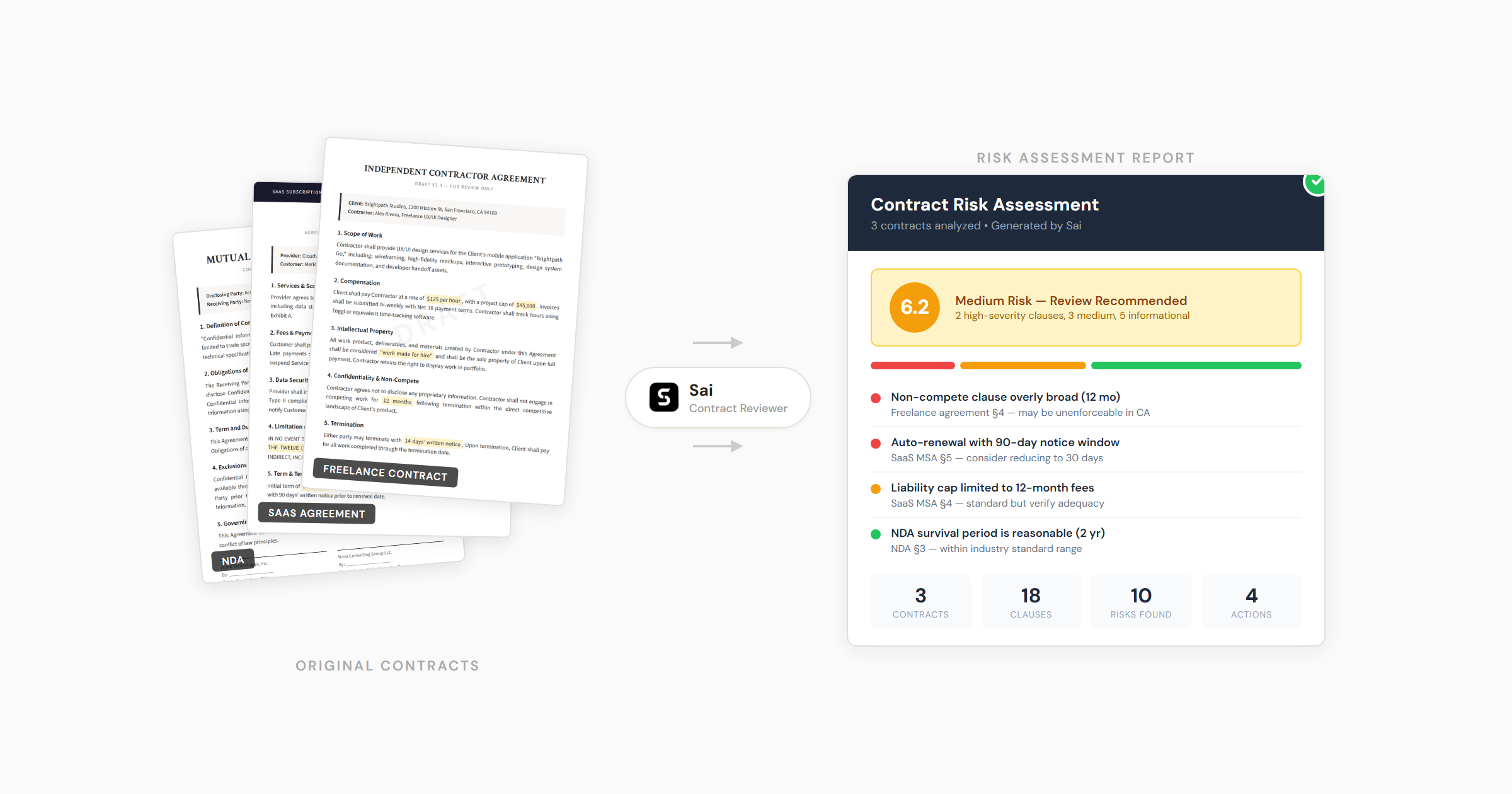
Score, compare, and track across multiple contracts.
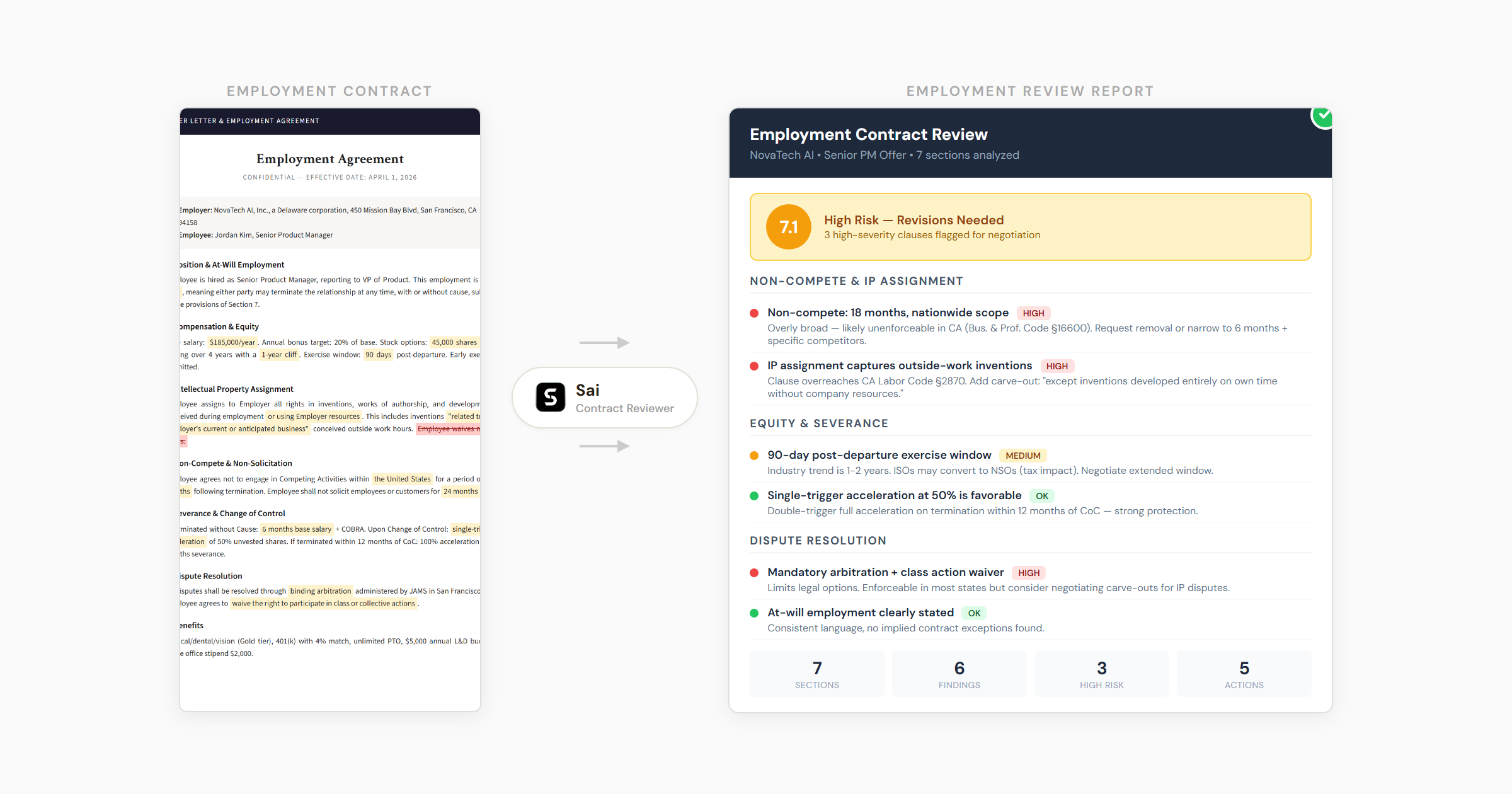
Generate and review in the same workflow.
A contract review is the process of reading a contract, identifying risks, verifying terms, and deciding whether to sign, negotiate, or walk away. It sounds straightforward — until you realize that most contract disputes happen because someone missed a single clause buried on page 14.
According to the International Association for Contract and Commercial Management (IACCM), poor contract management costs organizations 9% of their annual revenue on average. The most expensive contract mistakes are not bad negotiation — they are missed terms, auto-renewal traps, and liability clauses that nobody flagged during review.
This guide covers four methods for reviewing contracts, from fully manual to fully automated. Whether you are reviewing an employment contract before accepting a job offer, auditing a GSA consulting contract for compliance, or building a scalable contract review process for your legal team, the steps are the same — only the tools change.
A contract review is a systematic examination of a legal agreement to verify that the terms are accurate, complete, enforceable, and acceptable to all parties. The goal is to identify:
Missing provisions that should be included but are not
Unfavorable terms that create disproportionate risk for one party
Ambiguous language that could be interpreted differently during a dispute
Compliance issues with applicable laws, regulations, or internal policies
Financial exposure from liability caps, indemnification, penalties, and payment terms
Contract review is not the same as contract drafting. Drafting creates the document; review evaluates it. In practice, the two steps often overlap — a reviewer who finds problems may redline the contract and propose alternative language.
The Contract Review Checklist: 12 Points Every Review Must Cover
Whether you review contracts manually, with contract management software, or with AI, every review should address these 12 checkpoints. This checklist applies to employment contracts, consulting agreements, GSA contracts, vendor agreements, SaaS subscriptions, and leases.
1. Parties and Authority
Verify the full legal names of all parties. Confirm that the signatories have authority to bind their organizations. Check for "and/or assigns" language that allows one party to transfer obligations without consent.
2. Scope of Work and Deliverables
Ensure the scope is specific enough to measure performance. Vague language like "reasonable efforts" or "as needed" creates disputes. Compare the contract scope to any referenced SOW, proposal, or RFP.
3. Payment Terms
Confirm the total contract value, payment schedule, invoicing requirements, and late payment penalties. Check for automatic price escalation clauses. For employment contracts, verify base salary, bonus structure, equity, and clawback provisions.
4. Term and Renewal
Identify the start date, end date, and renewal mechanism. Auto-renewal clauses are one of the most commonly missed contract risks — some require 60 to 90 days advance notice to opt out, meaning you may be locked in before you realize the renewal window closed.
5. Termination Provisions
Review termination for convenience (can either party end the agreement without cause?), termination for cause (what triggers it?), and the cure period (how long does the breaching party have to fix the problem?). Check the notice period required for termination.
6. Liability and Indemnification
This is where the real risk lives. Check for:
Liability caps (or lack thereof — unlimited liability is a critical red flag)
Mutual vs. one-sided indemnification
Carve-outs that exclude certain damages from the liability cap
Insurance requirements that shift risk through coverage mandates
7. Intellectual Property
Who owns the work product? Who owns pre-existing IP used in the project? Are there license-back provisions? For employment contracts, check the IP assignment clause — some assign all inventions to the employer, even those created outside of work hours on personal equipment.
8. Confidentiality
Verify the definition of "confidential information" (is it overbroad or appropriately scoped?), the duration of confidentiality obligations (does it survive termination?), and any exceptions (public domain, independent development, required disclosures).
9. Non-Compete and Restrictive Covenants
For employment contracts specifically, review the non-compete scope (geographic area, industry, duration). Note that enforceability varies dramatically by state — California prohibits non-competes entirely, while Texas enforces them if they meet reasonableness requirements. The FTC has also proposed federal limits on non-compete agreements.
10. Dispute Resolution
Check whether disputes go to court or arbitration. If arbitration, who selects the arbitrator and who pays? Verify the governing law and venue. A contract governed by Delaware law with arbitration in New York creates different exposure than one governed by California law with litigation in Los Angeles.
11. Compliance and Regulatory
For GSA consulting contracts and government-related agreements, verify compliance with the Federal Acquisition Regulation (FAR), agency-specific provisions, and required certifications. For employment contracts, verify compliance with state labor laws, EEOC requirements, and industry-specific regulations.
12. Boilerplate Provisions
"Boilerplate" does not mean unimportant. Check force majeure (what events excuse performance?), assignment (can the contract be transferred?), severability (if one clause is void, does the rest survive?), waiver (does failing to enforce a provision waive the right to enforce it later?), and amendment (how are changes made?).
Method 1: Manual Contract Review
Manual review means reading the contract line by line, marking issues, and negotiating changes through email or redlines. This is how most contracts are still reviewed.
When to use: One-off contracts, high-value agreements (acquisitions, partnerships), or any contract with unusual terms that require human judgment.
Process:
Read the entire contract once without marking anything to understand the overall structure and intent
Review each section against the 12-point checklist above
Flag issues with severity ratings (critical, high, medium, low)
Research jurisdiction-specific requirements that apply
Draft redline language for provisions you want to change
Send the redlined version with a summary of requested changes
Track negotiation rounds until both parties agree
Time required: 2-6 hours for a standard commercial contract. 10-40 hours for complex agreements (M&A, commercial leases, enterprise SaaS).
Cost: Attorney rates range from $200-$800/hour depending on market and specialization. A single employment contract review typically costs $500-$2,000 for outside counsel.
Method 2: Contract Review with Legal Software
Contract management software digitizes the review process — storing contracts, tracking redlines, managing approvals, and maintaining a searchable repository. Some platforms (Juro, Ironclad, SpotDraft) include AI-assisted features.
When to use: Teams reviewing more than 10 contracts per month, or organizations that need audit trails and compliance reporting.
Popular tools: See our complete comparison of AI contract review tools for detailed evaluations.
Process:
Upload the contract to your CLM platform
System extracts metadata (parties, dates, values) and runs pre-configured checks
Reviewers annotate and redline within the platform
Automated routing sends the contract through approval workflows
E-signature integration captures execution
Repository stores the final version with full audit trail
Advantages over manual: Version control, searchable repository, approval routing, compliance reporting. Reduces the administrative overhead of review (tracking versions, chasing approvals) without replacing the substantive legal analysis.
Limitations: The software manages the workflow around review — it does not do the review itself. Someone still needs to read the contract, identify risks, and make judgment calls.
Method 3: AI Contract Review with Sai
AI contract review uses machine learning and natural language processing to analyze contract language, flag risks, identify missing provisions, and score the overall contract quality. Sai performs the substantive analysis that traditional contract management software leaves to humans.
When to use: Any contract review where you want a comprehensive first-pass analysis before human review, or routine contracts (NDAs, freelance agreements, standard vendor contracts) where AI can handle the full review.
How Sai Reviews a Contract:
Upload a contract (PDF or DOCX) and Sai produces a structured risk assessment:
Contract type detection: Automatically identifies whether the document is an NDA, employment agreement, SaaS license, consulting agreement, or one of seven other contract types
Full-text analysis: Reviews every clause against legal standards and industry best practices
Risk flagging: Categorizes issues by severity:
CRITICAL: Unlimited liability exposure, missing indemnification, one-sided termination rights
HIGH: No termination for convenience, auto-renewal with 60+ day opt-out, missing governing law
MEDIUM: One-sided confidentiality, broad non-compete (12+ months), no force majeure clause
LOW: Minor formatting issues, suggested improvements, optional provisions
Missing clause identification: Flags provisions that are standard for the contract type but absent from the document
Scoring: Rates the contract across 10 dimensions (payment terms, liability, termination, IP, dispute resolution, compliance, performance obligations, insurance, amendment provisions, boilerplate completeness) on a 0-10 scale
Output:A structured report with the overall contract score, issue-by-issue breakdown with severity ratings, specific clause references, and actionable recommendations for each flagged item.
What Sai catches that manual reviewers commonly miss:
Auto-renewal traps with unreasonably short opt-out windows
Liability carve-outs that effectively eliminate the liability cap
Non-compete clauses that are unenforceable in the governing jurisdiction
Missing standard provisions for the specific contract type
Inconsistent definitions (a term defined differently in two sections)
If you also need to generate contracts, Sai handles that in the same platform — see our AI contract generator comparison for details.
Employment Contract Review: Special Considerations
Employment contracts require attention to provisions that do not appear in other agreement types. This applies whether you are an employee reviewing an offer or an HR team standardizing employment agreements.
Key provisions to review in employment contracts:
At-will language: Most US states default to at-will employment, but the contract may create exceptions. Ensure the at-will disclaimer is clear and not contradicted by other provisions.
Non-compete and non-solicitation: Check scope (geographic area, duration, industry). Some states (California, Minnesota, Oklahoma, North Dakota) ban non-competes outright.
IP assignment: "Work for hire" vs. broad assignment clauses. Some assignment language captures inventions created outside of work — California Labor Code 2870 limits these clauses.
Severance and termination: What triggers severance? Is there a change-of-control provision? Do stock options accelerate?
Benefits and equity: Confirm vesting schedule, cliff period, exercise window after departure, and tax treatment (ISO vs. NSO).
Arbitration: Many employment agreements require binding arbitration with class action waivers. Know what you are agreeing to.
GSA Consulting Contracts Review: Federal Requirements
GSA (General Services Administration) consulting contracts have unique review requirements beyond standard commercial agreements. These contracts fall under the Federal Acquisition Regulation (FAR) and require compliance with provisions that private-sector contracts do not include.
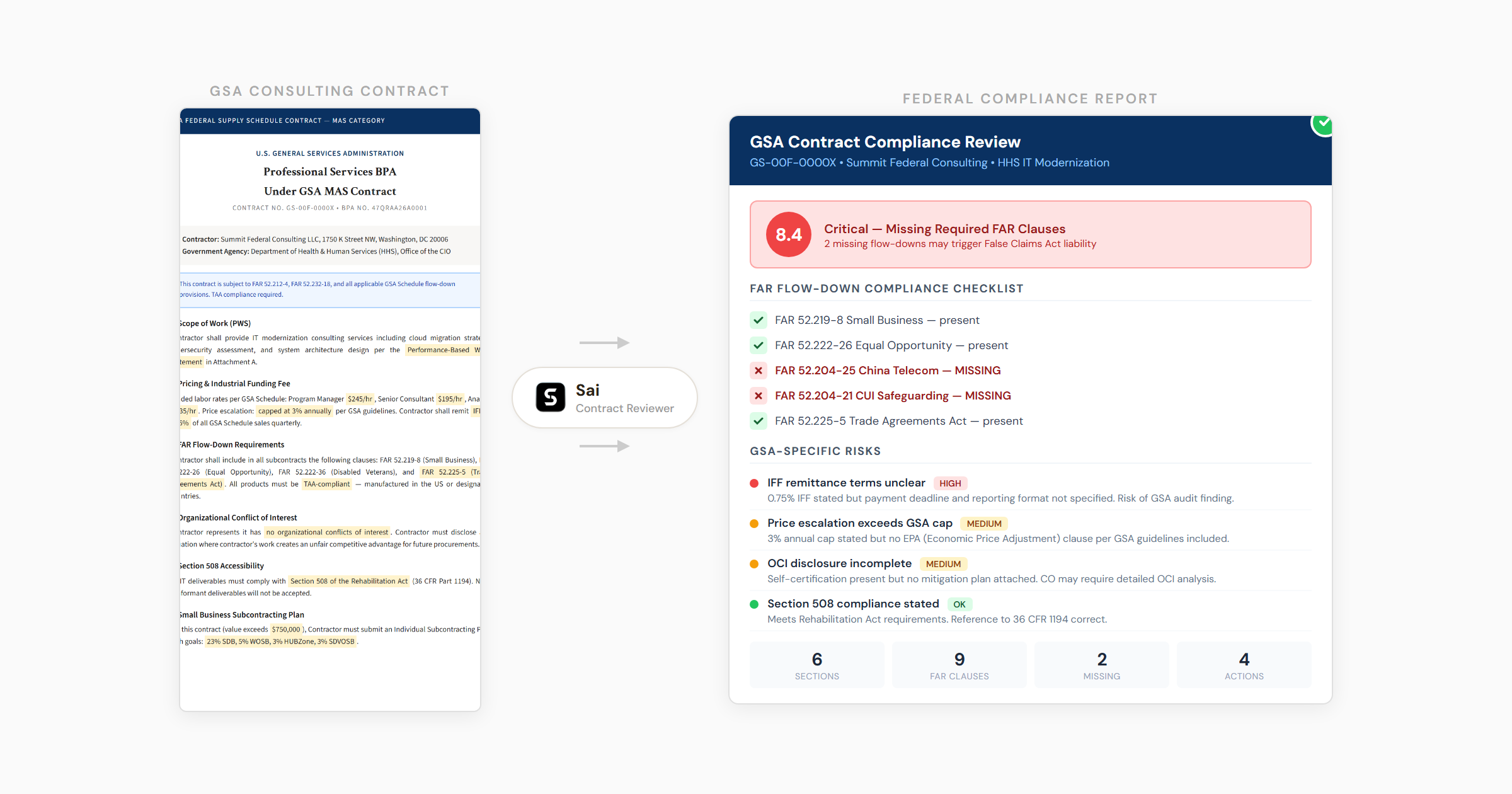
GSA-specific review checklist:
FAR compliance clauses (required flow-downs for subcontractors)
GSA Schedule pricing (price escalation must follow GSA guidelines)
Organizational conflict of interest (OCI) provisions
Section 508 accessibility compliance (for IT consulting)
Small business subcontracting plan (for contracts over $750K)
Performance-based work statement vs. statement of work
Government property and data rights clauses
Common risks in GSA contract reviews:
Most GSA consulting contract issues arise from flow-down requirements — provisions the prime contractor must include in subcontracts. Missing a required flow-down can trigger contract termination or False Claims Act liability.
Stop doing repetitive tasks. Let Sai handle them for you.
Sai is your AI computer use agent — it operates your apps, automates your workflows, and gets work done while you focus on what matters.

.svg)

.svg)