Oops! Something went wrong while submitting the form.
Blog Writing: How to Create SEO-Optimized Content That Ranks and Gets Cited
Your AI blog posts are not ranking because you skip SERP research and ignore GEO. Learn the 7-step framework that turns AI drafts into content that ranks on Google and gets cited by ChatGPT and Perplexity.
Why Does AI Blog Writing Still Produce Content That Fails to Rank?
Automated SERP and Competitor Research
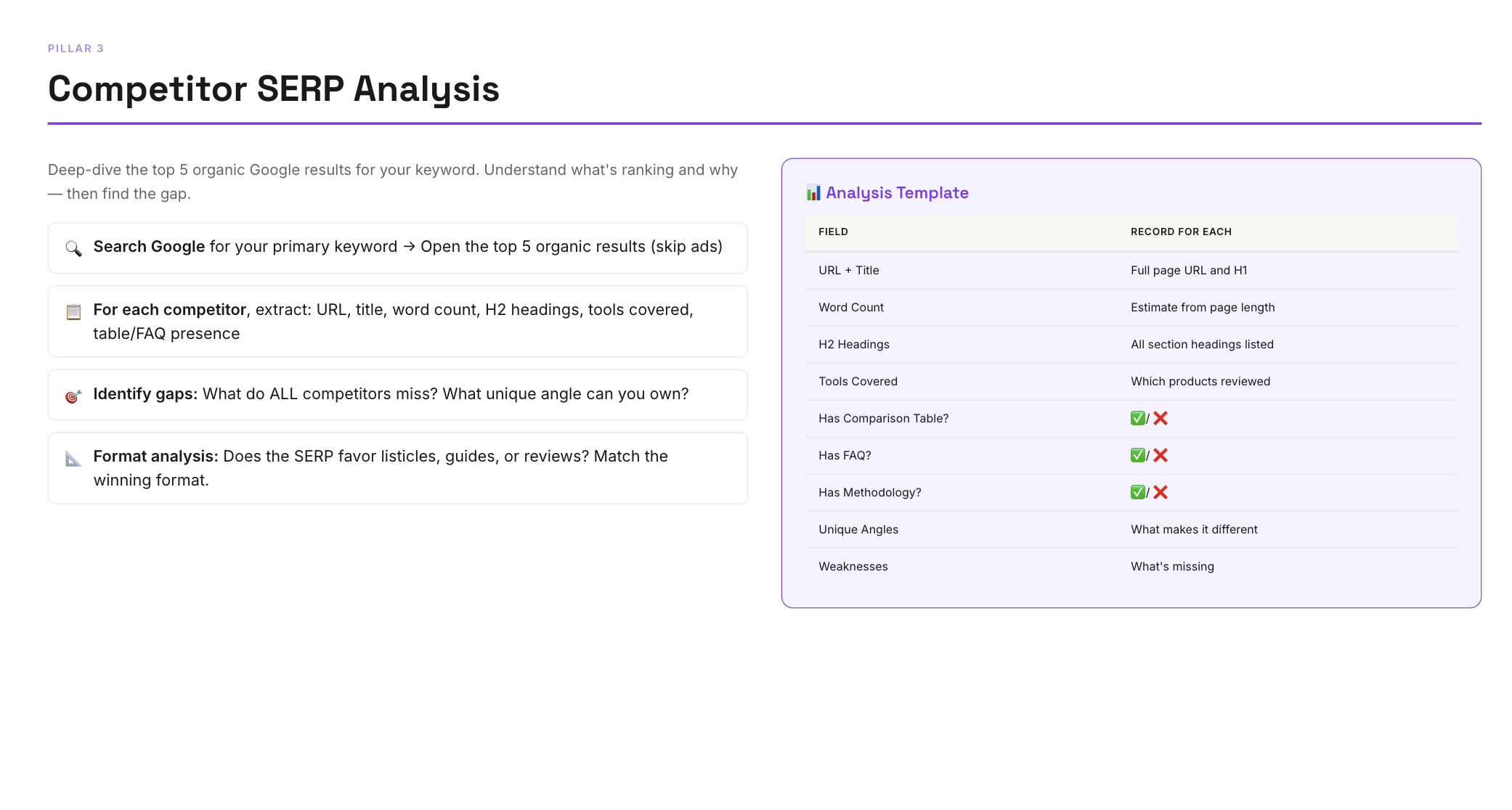
Sai opens Google, searches your target keywords, visits the top 10 ranking pages, extracts their heading structures, word counts, and content gaps -- then compiles a competitive brief in a Google Sheet in under three minutes per keyword.
End-to-End Draft Production
Sai generates structured first drafts in Google Docs with proper H2/H3 hierarchy, internal links pulled from your sitemap, verified data citations with source URLs, and FAQ sections formatted for schema extraction -- reducing draft time from four hours to under forty minutes.
Publish-and-Distribute Workflow
After you approve the final draft, Sai schedules the article for CMS upload, generates social media posts for LinkedIn and X, drafts a newsletter announcement in Gmail, and sets a Google Calendar reminder to check rankings after 14 days -- turning a single blog post into a coordinated content launch.
Why Does AI Blog Writing Still Produce Content That Fails to Rank?
Most blog content produced with AI tools in 2026 disappears into the void. Despite the widespread adoption of AI writing assistants, the majority of AI-assisted blog posts never reach Google's first page.
The problem is not the technology. It is how teams use it:
They skip the research phase entirely. The most common blog writing mistake -- with or without AI -- is writing before understanding what already ranks. 88% of marketers now use AI daily for content production (Averi, 2026), but most use it to generate drafts without first analyzing the SERP landscape, competitor depth, or search intent.
They publish first drafts without human editing. AI produces serviceable prose, but it does not produce expertise. 86% of marketers still refine AI drafts manually to maintain quality (Averi, 2026), and the 14% who do not are producing content that reads like every other AI-generated article on the same topic.
They optimize for Google but ignore AI search engines.AI Overviews now appear in 80% of informational searches(Typeface, 2026), meaning content must be structured for extraction by AI models -- direct answers under question headings, comparison tables, self-contained answer blocks -- not just traditional keyword placement.
What Is AI Blog Writing?
AI blog writing is a content production method that uses artificial intelligence at each stage of the blogging workflow -- from topic ideation and keyword research through drafting, editing, SEO optimization, and distribution. It is not a single tool. It is a process that layers AI capabilities across the entire content pipeline.
Topic and keyword research -- identifying search queries with commercial or informational intent, analyzing search volume, and mapping keyword clusters
SERP and competitor analysis -- reviewing what already ranks, identifying content gaps, and determining the depth and angle required to compete
Content brief creation -- defining the target word count, heading structure, required data points, internal links, and SEO formatting requirements
First-draft generation -- producing structured prose with proper heading hierarchy, natural keyword placement, and supporting evidence
Human editing and fact-checking -- refining voice, verifying all data citations, adding original insights, and ensuring the content passes E-E-A-T standards
Publishing, distribution, and performance tracking -- uploading to CMS, scheduling social promotion, and monitoring rankings over time
Most AI writing tools handle stage four alone. Some add basic keyword suggestions (stage one) or templated outlines (stage three). Sai handles all six stages in a single automated workflow -- from opening Google to researching competitors, drafting in Google Docs, and scheduling distribution posts across channels.
How to Create SEO-Optimized Blog Content with AI (Step-by-Step)
Step 1: Mine Keywords and Map Search Intent
Every effective blog post starts with a keyword that real people are actually searching for. Before you write a single word, you need to know the search volume, the competition level, and most importantly, the intent behind the query.
Sai automates this by opening Google, Ahrefs (or your preferred SEO tool), and Google Search Console side by side. It enters your seed topic, pulls keyword suggestions with volume and difficulty scores, and categorizes each keyword by intent: informational ("what is AI blog writing"), commercial investigation ("best AI blog writing tools"), or transactional ("AI blog writing service pricing"). The result is a Google Sheet with your keyword map, ready for content planning.
The critical nuance most blog writing tips overlook: intent determines structure. An informational query needs a comprehensive guide with definitions and step-by-step instructions. A commercial query needs comparison tables and specific recommendations. Writing a listicle when the searcher wants a tutorial -- or vice versa -- is the fastest way to guarantee your content never reaches page one.
Step 2: Analyze the SERP and Reverse-Engineer What Ranks
After selecting your target keyword, you need to understand what Google is currently rewarding for that query. This means visiting the top five to ten ranking articles and extracting their structural patterns.
Sai opens each ranking URL in sequence, extracts the heading hierarchy (H1, H2, H3 structure), counts the word length, identifies whether the page includes comparison tables or FAQ sections, and checks for schema markup. It compiles all of this into a competitive analysis brief. This brief shows you the minimum depth required to compete -- if every ranking article is 2,500+ words with comparison tables and FAQ schema, your 800-word draft will not rank regardless of how well it is written.
This is where most blog writing examples in AI writing tool marketing fall short. They show you a finished draft but never show you the research that should have preceded it.
Step 3: Build a Content Brief with Specific Requirements
A content brief is the blueprint that separates professional AI blog writing from "just asking ChatGPT to write something." Your brief should specify the exact heading structure, target word count, required internal links, data points to include, and the GEO optimization principlesthat make content citable by AI engines.
Sai generates this brief automatically from the SERP analysis. It creates a Google Doc outline with suggested H2 and H3 headings framed as questions (which are more extractable by AI search engines), slots for verified statistics with source URLs, and placeholders for comparison tables. It also pulls your site's internal link inventory and suggests four to six contextual links to existing pages.
One blog writing tip that separates mediocre content from authoritative content: your brief should require at least three original insights or frameworks that no competitor article includes. This is your "citability moat" -- the unique value that makes AI models reference your article instead of one of the ten others covering the same topic.
Step 4: Generate a Structured First Draft
With a detailed brief in hand, AI draft generation becomes far more effective. Instead of asking an LLM to "write a blog post about X," you are providing specific structural, factual, and strategic constraints.
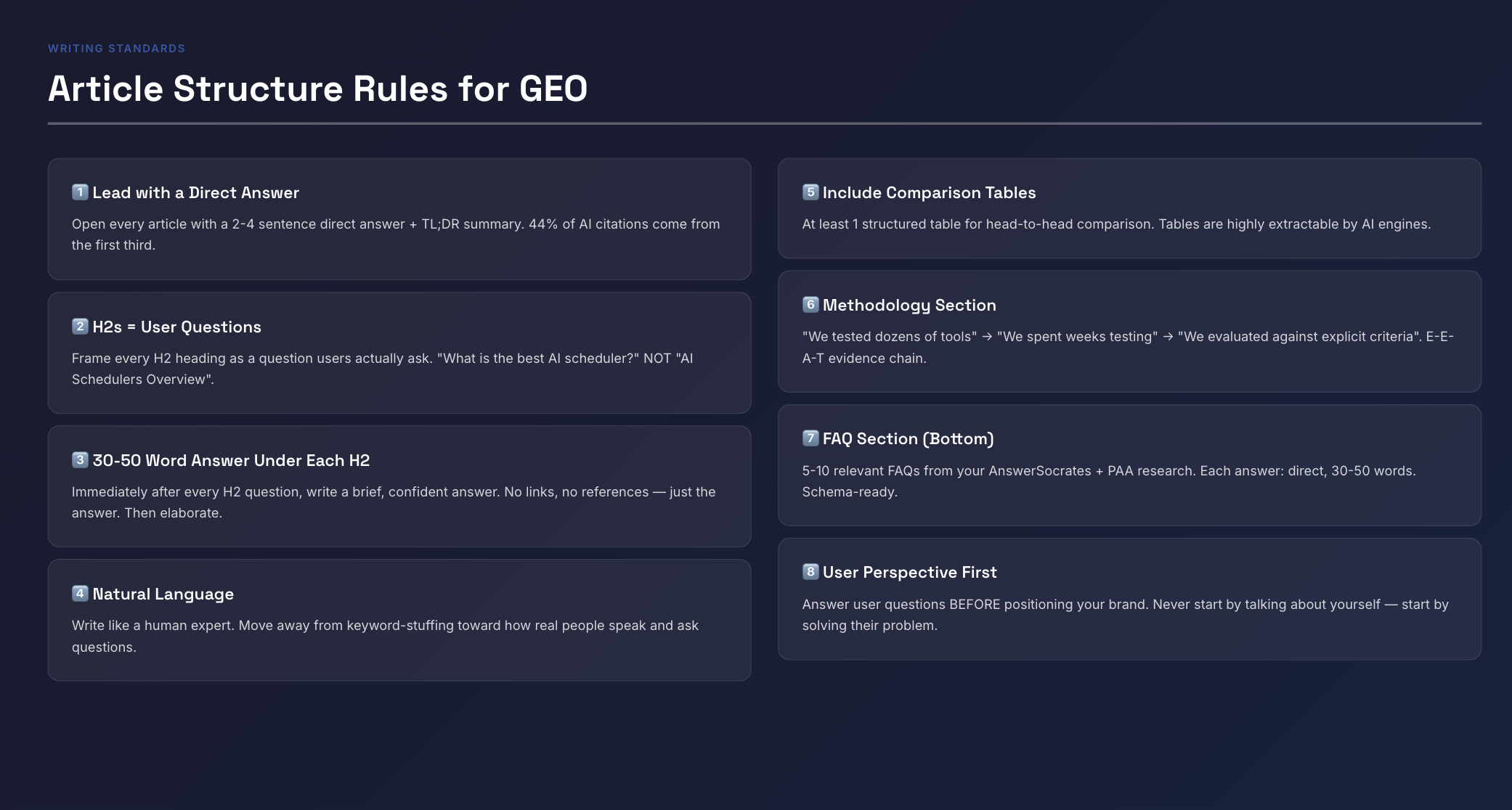
Sai drafts directly in Google Docs, following the brief's heading structure. It generates content section by section, inserting verified data points with hyperlinked source citations, building comparison tables in HTML format, and creating FAQ sections with direct answers under each question heading. Every H2 is framed as a question. Every question heading is followed by a 30-to-50-word direct answer before the detailed explanation begins -- a GEO optimization patternthat significantly increases the likelihood of AI citation.
Before (generic AI output):
"AI blog writing is becoming increasingly popular. Many marketers are using AI tools to create content. There are many benefits to using AI for blog writing, including saving time and improving quality."
After (Sai-optimized draft following the content brief):
"AI blog writing compresses the mechanical stages of content production -- keyword research, SERP analysis, first-draft generation, and SEO formatting -- so writers can focus on strategy and originality. In 2026, 94% of marketers plan to use AI for content creation, and teams using AI spend less than one hour producing long-form posts that previously took two to three hours (Averi, 2026). But speed without structure produces commodity content. The difference between an AI-written article that ranks and one that disappears is the research and optimization framework applied before and after the draft."
Step 5: Edit for Voice, Accuracy, and E-E-A-T Signals
No AI draft should be published without human editing. This is the step that separates authoritative content from the sea of AI-generated commodity text flooding every search result.
Your editing pass should check for three things: voice (does it sound like your brand, not a generic LLM?), accuracy (does every statistic link to a verified original source?), and E-E-A-T signals (does the content demonstrate experience, expertise, authoritativeness, and trustworthiness?).
Sai assists this step by flagging any data point in the draft that lacks a source URL, highlighting sections where the prose is too generic or closely matches competitor phrasing, and suggesting opportunities to insert original insights or expert perspectives. But the final editorial judgment stays with you. As Andy Crestodina, co-founder of Orbit Media Studios, has noted: "AI is amazing at producing first drafts. But the magic is in the editing. The best content marketers are becoming expert editors, not expert prompters."
Step 6: Optimize for Both Google and AI Search Engines
Traditional SEO optimization -- title tags, meta descriptions, keyword density, alt text -- still matters. But in 2026, you also need to optimize for Generative Engine Optimization. This means structuring your content so AI models can extract, cite, and attribute your insights.
The key GEO principles for blog writing:
Lead with direct answers. Under every H2 question heading, write a 30-to-50-word answer immediately. No preamble.
Use comparison tables. AI models extract tabular data more reliably than prose. Include at least one HTML comparison table per article.
Maintain citation density. Every data claim links to its original source. AI models weight content with verifiable citations higher than unsourced assertions.
Create self-contained answer blocks. Each section should be independently extractable -- a complete answer that makes sense without reading the rest of the article.
Sai runs a final optimization pass through your finished draft, checking heading structure against GEO principles, verifying all source links are functional, and confirming keyword placement meets density targets without over-optimization.
Step 7: Schedule Publishing, Distribution, and Performance Monitoring
A blog post is not done when you hit publish. The most effective content marketers follow a coordinated distribution sequence that amplifies reach across channels.
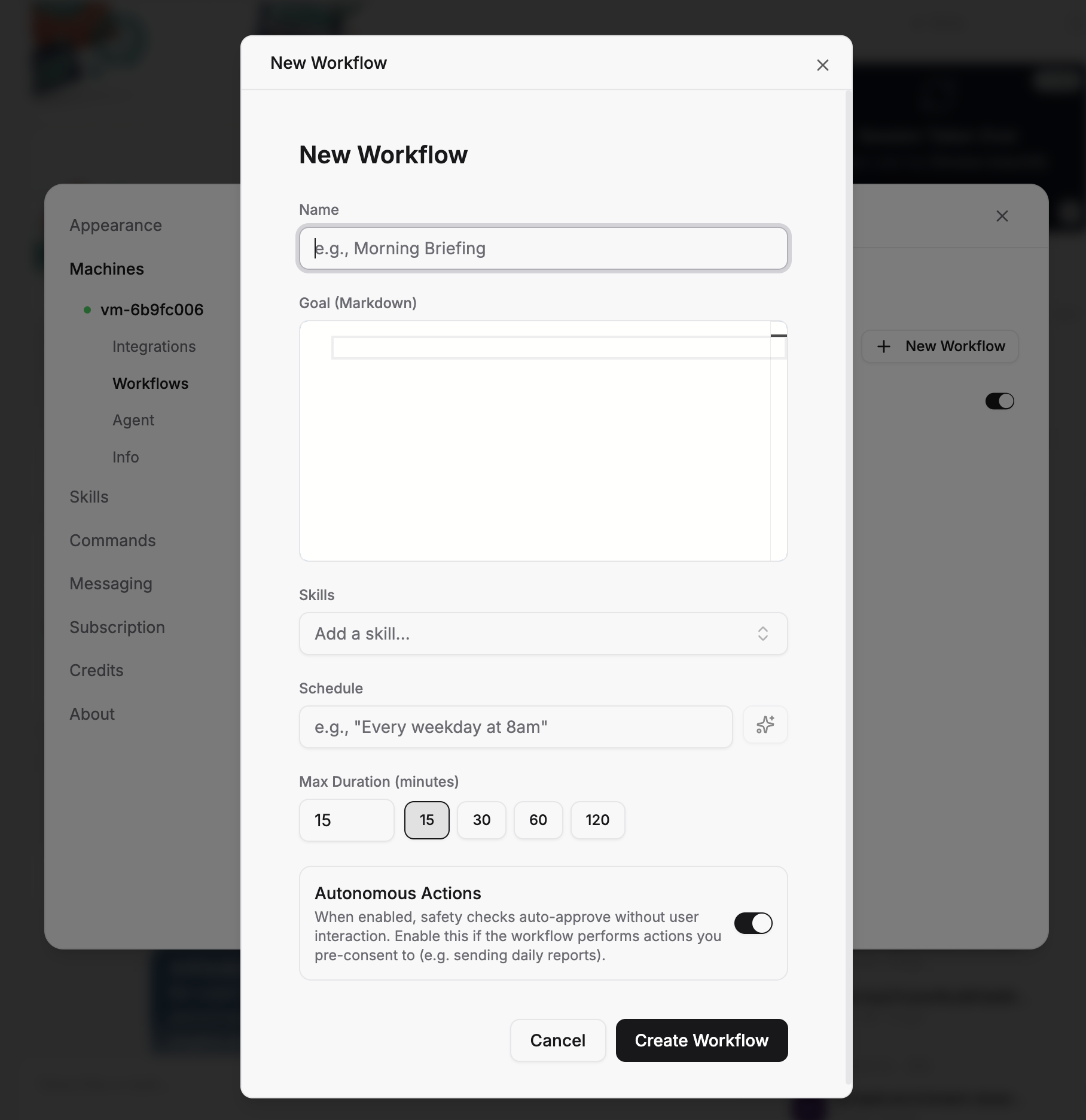
Sai automates this as a scheduled workflow. After you approve the final draft, it uploads the content to your CMS, generates LinkedIn and X posts tailored to each platform's format, drafts a newsletter segment in Gmail for your subscriber list, and sets a recurring Google Calendar reminder to check Search Console rankings at 7, 14, and 30 days post-publish. If the article enters the top 20 for its target keyword within 30 days, Sai flags it for a content refresh to push for page-one positioning.
Stop doing repetitive tasks. Let Sai handle them for you.
Sai is your AI computer use agent — it operates your apps, automates your workflows, and gets work done while you focus on what matters.

.svg)


.svg)