
Oops! Something went wrong while submitting the form.
The first time your inbox filled up overnight with demo requests, it felt like magic. Then you opened your CRM the next morning and realized half the “leads” were junk, and your team was still stuck exporting CSVs, copy‑pasting into sequences, and chasing ghosts. The promise of AI lead generation was more pipeline with less work. The reality, for many B2B teams, has been more tools and the same late nights.
That’s why “best ai for b2b lead generation” needs a clearer definition. At its core, this category covers tools that use machine learning and automation to find, score, and engage prospects so your sales and marketing teams can focus on conversations, not spreadsheets. Platforms like Amplemarket, ABM suites such as Demandbase, and free stacks highlighted by Leadpages all lean on AI to interpret intent signals, enrich contact data, and trigger outbound at scale. The upside: less manual prospecting, richer context, and faster handoffs. The trade‑offs: data gaps, browser‑only limits, and the risk of over‑automating your way into low‑quality “AI‑generated” leads that never convert.
In this guide, we’ll look at the top alternatives to the usual “best ai for b2b lead generation” suspects—especially if you’re a founder, agency owner, or revenue leader who wants real pipeline, not dashboards. We’ll compare classic browser tools to full computer agents that can actually operate your desktop, and unpack when you need a copilot vs a truly autonomous coworker.
When we evaluate the best ai for b2b lead generation tools and their alternatives, we don’t just read feature pages—we run them like a revenue team would.
We built a handful of repeatable GTM scenarios (outbound prospecting, event follow‑up, and churn‑risk winbacks) and asked each platform to execute as much of the workflow as possible. Then we scored tools across five dimensions:
For Simular Pro, we also pushed long‑horizon, high‑step workflows (thousands of actions across desktop, browser, and cloud) to test the production‑grade reliability its agent architecture promises. We then compared that to more conventional tools from sources like Amplemarket’s 15‑tool benchmark, Demandbase’s B2B AI roundup, and GTM‑focused automation platforms covered by Gumloop.
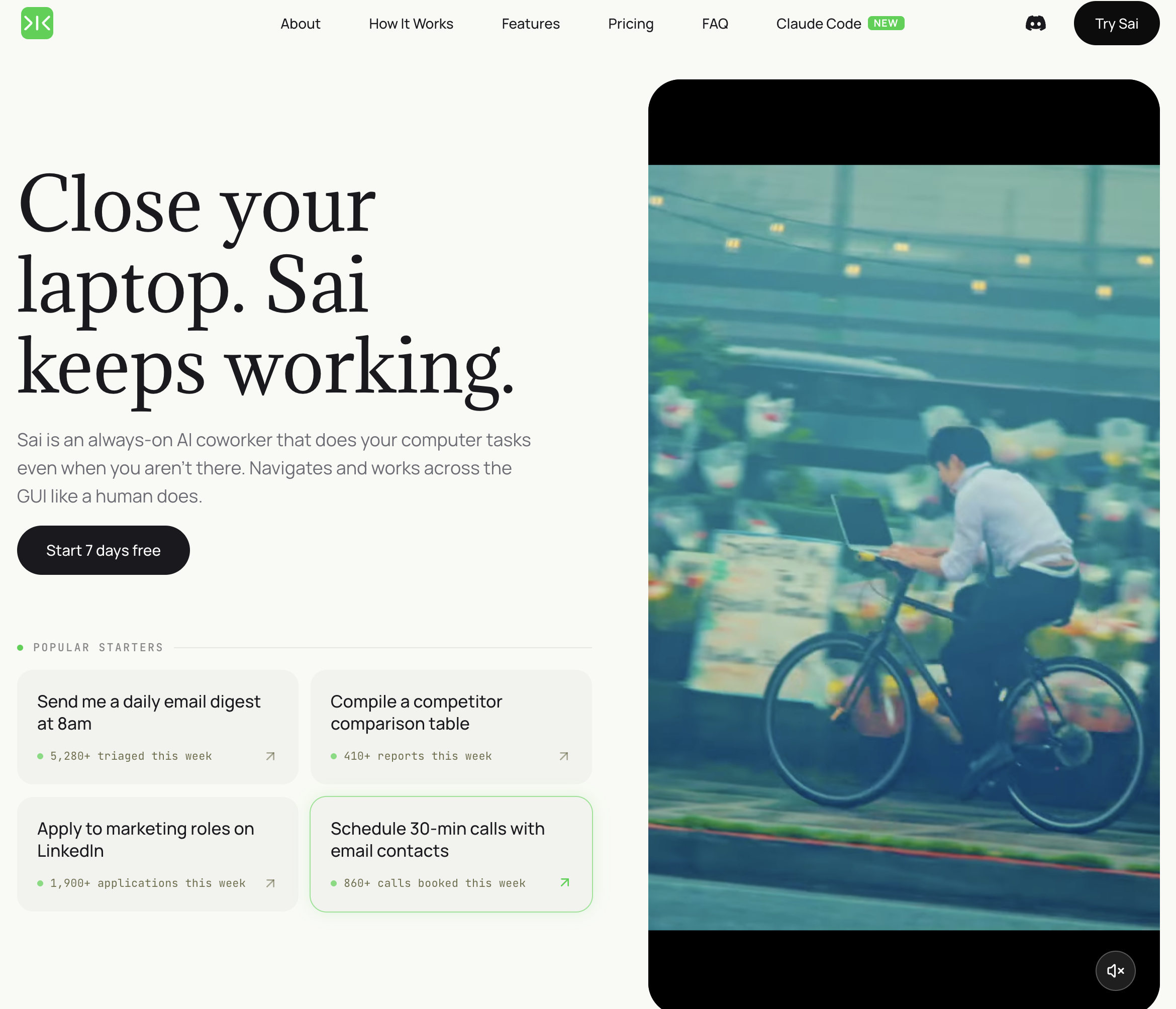
Pricing: Free tier available; Pro from $20/month Platform: Desktop AI agent (Windows/Mac) Best for: SMBs that need prospect research, enrichment, and outreach in one tool without data provider subscriptions
Sai approaches lead generation fundamentally differently from every other tool on this list. Instead of selling you a database of contacts, Sai operates your computer like a human research assistant — searching LinkedIn, Google, company websites, and news sources to build prospect profiles from scratch.
What Sai does that other tools do not:
Limitations: Requires your computer to be running during prospecting runs. Data quality depends on what is publicly available — if a prospect has a sparse LinkedIn profile and no company news coverage, the enrichment will be thinner than a paid database lookup. Does not provide direct phone numbers or personal emails (focuses on LinkedIn and business email enrichment).
Who should pick Sai: SMBs and solo founders who are currently doing manual prospect research and cannot justify $15,000+/year data provider subscriptions. If your current workflow involves opening 10 browser tabs per prospect and copy-pasting information into a spreadsheet, Sai automates exactly that.
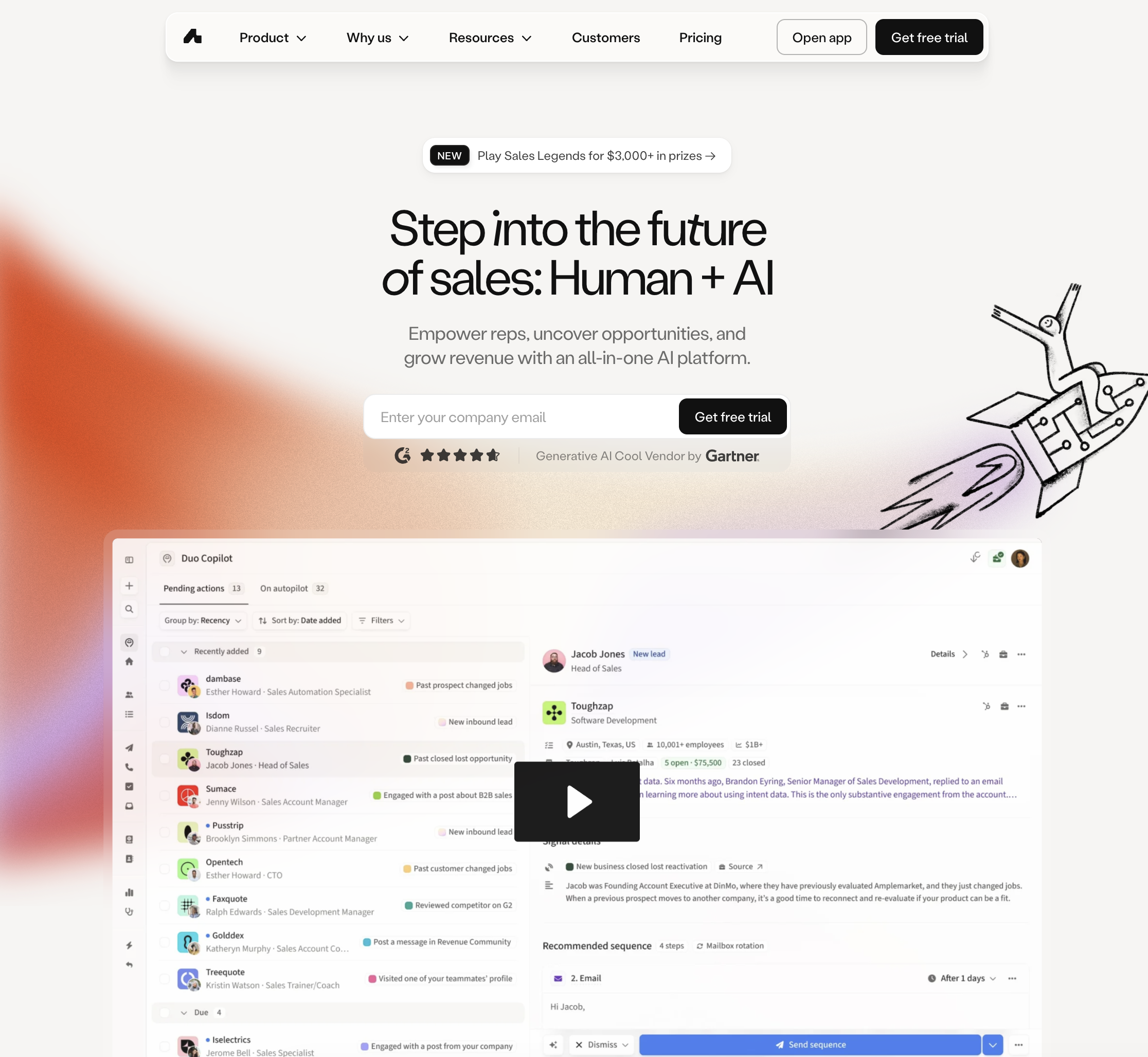
Pricing: Contact for pricing (typically $1,000+/month) Platform: Cloud-based SaaS Best for: Mid-market sales teams that want a single platform covering data, sequencing, and AI-written messaging
Amplemarket combines a B2B contact database with multichannel sequencing and AI-assisted copywriting. It positions itself as the "all-in-one" platform that replaces separate data, outreach, and engagement tools.
Key strengths:
Limitations: Pricing puts it firmly in mid-market territory — most SMBs will find it cost-prohibitive. The platform's complexity means a steeper learning curve and longer time to first campaign. AI copywriting quality, while decent, still produces templates that need human editing for high-value prospects. Data coverage can be uneven outside of North America.
Who should pick Amplemarket: Sales teams of 5+ reps who want to consolidate data provider, sequencing, and engagement tools into a single platform and have the budget to support it.
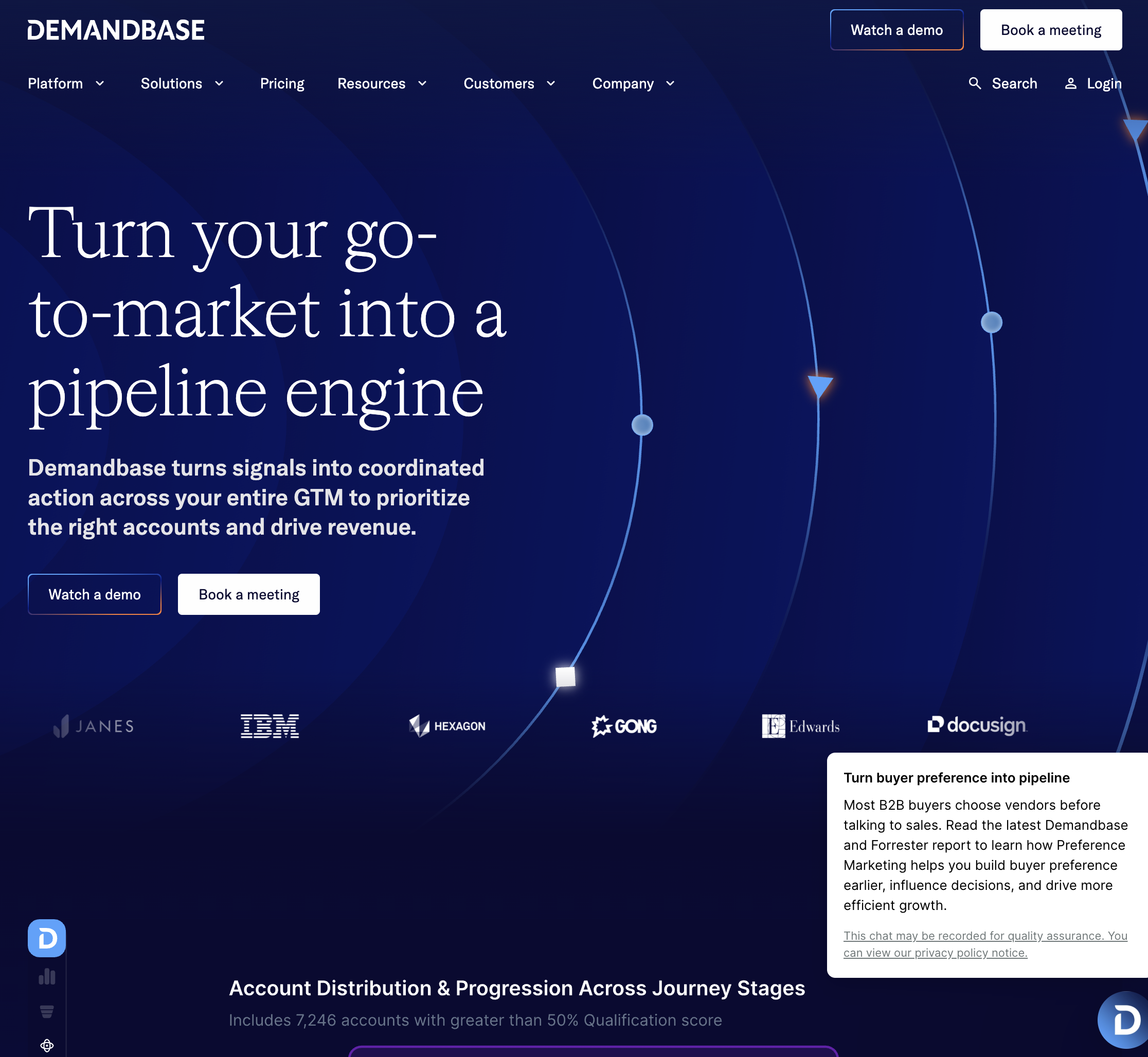
Pricing: Contact for pricing (enterprise, typically $25,000+/year) Platform: Cloud-based ABM platform Best for: B2B companies running account-based marketing strategies who need to identify in-market accounts
Demandbase is not a prospecting tool in the traditional sense — it is an account-based marketing platform that identifies which companies in your target market are actively researching solutions like yours. It works at the account level, not the contact level.
Key strengths:
Limitations: Enterprise pricing puts it out of reach for most SMBs. Requires a defined target account list and ABM strategy to be effective — not useful for wide-net prospecting. Intent data is aggregated at the company level, not individual contact level, so you still need a separate tool to find the right person within an account.
Who should pick Demandbase: B2B companies with an established ABM strategy, a defined target account list, and the budget for enterprise-grade tooling. Not the right fit for SMBs doing broad prospecting.
Pricing: Free tier (50 credits); Pro from $147/month Platform: Cloud-based + Chrome extension Best for: SDRs who need large volumes of verified emails and phone numbers quickly
Seamless.AI is a contact data provider that uses AI to verify and surface email addresses and phone numbers in real time. Its primary value proposition is speed: find a prospect on LinkedIn, click the extension, and get their verified contact information instantly.
Key strengths:
Limitations: Seamless.AI provides data, not automation. It tells you how to reach someone but does not research them, write messages, or handle follow-up sequences. You still need a separate sequencing tool (Outreach, Salesloft, Apollo) for the actual outreach. Data accuracy, while generally good, varies by region — North American coverage is strongest. The credit-based pricing model can become expensive at high volumes.
Who should pick Seamless.AI: SDRs who already have a sequencing tool and just need better contact data. If your bottleneck is "I cannot find verified emails and phone numbers for my prospects," Seamless.AI solves that specific problem efficiently.
Pricing: Free tier available; Pro from $49/month Platform: Cloud-based workflow builder Best for: Technical users who want to build custom AI-powered lead generation pipelines with flexible logic
Gumloop is a visual workflow builder that lets you chain together AI agents, web scrapers, data enrichment tools, and outreach actions into custom lead generation pipelines. Think of it as Zapier for AI agents — you design the workflow, and Gumloop executes it.
Key strengths:
Limitations: Requires technical setup — this is a workflow builder, not a turnkey solution. You need to design, test, and iterate on your pipelines. The learning curve is steeper than tools with pre-built templates. Workflow reliability depends on the stability of the data sources you connect (websites change, APIs break). No built-in contact database — you bring your own data sources.
Who should pick Gumloop: Technical founders, growth engineers, and RevOps teams who want maximum flexibility in how they build their lead gen process. If you have specific data sources or scoring logic that off-the-shelf tools do not support, Gumloop lets you build exactly what you need.
Beyond these five, there’s a long tail of best ai for b2b lead generation contenders: data providers like Cognism, marketing clouds like Salesforce and HubSpot, and free tools like Leadfeeder, Mailchimp, and Intercom, highlighted in resources from Demandbase, Amplemarket, and Leadpages.
They all do pieces of the puzzle—data, scoring, email, chat, ads. The real question is: do you want more specialized tools, or an AI coworker that sits above them and actually does the computer work?
If you’re a small team, agency, or growing B2B company, Simular Pro is designed to be that coworker: a transparent, guardrailed desktop agent that can read your playbook and run the steps, day after day. You keep control of the strategy and the sensitive decisions; Simular handles the clicking, typing, and tab juggling.
Try Simular when you’re ready to move from "yet another AI tool" to an agent that actually logs into your stack and gets the work done.
Sai is an AI agent that runs directly on your computer — no browser extensions, no data subscriptions, no monthly contact credits. Three capabilities make it uniquely suited for B2B lead generation: